Short Link Statistics 2026: Mobile vs Desktop Clicks, Bots and Safety (FattyURL Data)
First-party URL shortener statistics for 2026: 83.4% of clicks on FattyURL short links came from phones and 10.1% from desktops. About 5 in 10,000 safety rechecks, run after a link was made, found a destination Google listed as unsafe.
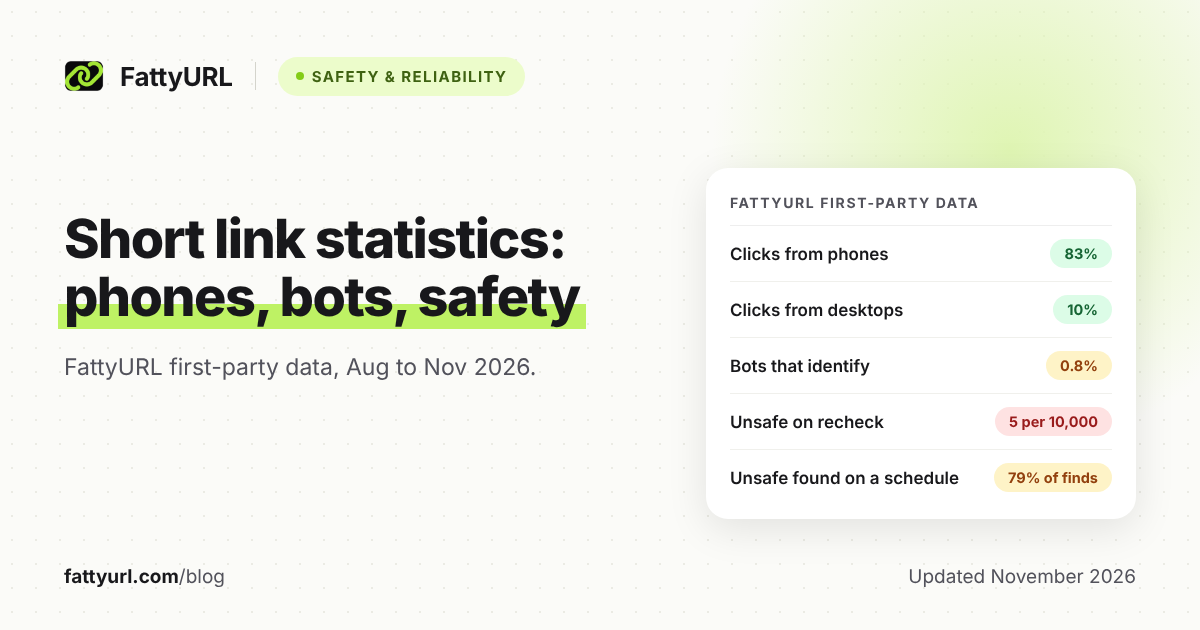
On FattyURL, most short link clicks happen on phones. Of every click recorded on FattyURL short links between 1 August and 31 October 2026, 83.4% came from phones and 10.1% from desktop computers.
On safety, 99.76% of FattyURL's recorded checks from early October to 14 November 2026 were clean. Every unsafe verdict came from a recheck, after the link was made.
Short answer: In FattyURL's own data for August to October 2026, 83.4% of short link clicks came from phones and 10.1% from desktops. From early October to 14 November 2026, about 5 in 10,000 safety rechecks (roughly 1 in 2,000) found a destination Google listed as unsafe. None was found at creation, where a listed destination is refused.
What are the key short link statistics for 2026?
These short link and URL shortener statistics are FattyURL's own first-party numbers, shown as shares only and computed on 14 November 2026. The click figures cover every click recorded on FattyURL short links from 1 August to 31 October 2026. The safety figures cover every safety check FattyURL recorded from early October to 14 November 2026.
- Phones: 83.4% of clicks, about 5 in 6.
- Desktops: 10.1%, about 1 in 10. Tablets: 0.9%.
- Unlabeled: 4.9% had no user agent that could be classified.
- Bots: at least 0.8%, counting only bots that identify themselves.
- Clean checks: 99.76% of safety checks found nothing wrong.
- Caught on recheck: about 5 in every 10,000 rechecks found a destination Google listed as unsafe.
- Found after creation: all unsafe verdicts, 79% at a scheduled recheck and 21% at a click-time recheck.
Are short links clicked more on mobile or desktop?
Mobile, by a wide margin. Phones made 83.4% of clicks on FattyURL short links from 1 August to 31 October 2026, about 5 in every 6. Desktop computers made 10.1%, about 1 in 10, and tablets 0.9%, based on the user agent each click's browser sent.
FattyURL first-party data: every click recorded on FattyURL short links, 1 August to 31 October 2026. Computed 14 November 2026.
| Device type | Share of clicks | Roughly |
|---|---|---|
| Phone | 83.4% | 5 in 6 clicks |
| Desktop | 10.1% | 1 in 10 |
| Unknown (no user agent that could be classified) | 4.9% | 1 in 20 |
| Tablet | 0.9% | About 1 in 110 |
| Known bots and crawlers | 0.8% | About 1 in 125 |
The mix changes from month to month. In August, phones and desktops each took close to half of clicks. In September and October, phones took more than 80%.
The three-month figure counts every click equally, so the busier months weigh more. Read 83.4% as a picture of this period, not a fixed rule.
How many short link clicks come from bots?
At least 0.8%. That is the share of clicks on FattyURL short links that came from bots and crawlers naming themselves in their user agent. Automated traffic that does not identify itself lands in the other rows, so the true share is likely higher.
Bots that name themselves include link-preview bots. Some apps fetch a shared link first so they can show a preview card. Meta, for example, documents a crawler called facebookexternalhit that fetches shared links to show their title, description and thumbnail.
If a preview does not appear, see why a link preview is not showing and how to fix it.
Another 4.9% of clicks came with no user agent, or one that could not be recognized. Our best reading is that many are in-app browsers or tools that strip headers, but the data cannot confirm that.
How safe are short links, by the numbers?
Almost every check came back clean: of every safety check FattyURL recorded between early October and 14 November 2026, 99.76% found nothing wrong. Google Web Risk listed the destination as unsafe in 0.05% of checks. Another 0.17% flagged a link for a person to review, and in 0.03% Web Risk did not answer.
FattyURL first-party data: every safety check FattyURL recorded, early October to 14 November 2026. Computed 14 November 2026.
| Check result | Share of all checks |
|---|---|
| Clean | 99.76% |
| Flagged for a person to review (a FattyURL rule, not Google) | 0.17% |
| Listed as unsafe by Google Web Risk | 0.05% |
| Web Risk did not answer | 0.03% |
Most checks were rechecks. Scheduled rechecks made up 78.7% of all checks, click-time rechecks 16.1%, checks at creation 5.2% and checks after an edit under 0.1%.
Only a Google Web Risk hit pauses a link automatically, and paused links are never deleted. A link that breaks one of FattyURL's own rules is flagged for a person to decide. Working links are not switched off for that, and all of these flags came from scheduled rechecks.
How often do short links turn malicious?
Rarely, and in this data it was always found after the link was made. About 5 in every 10,000 FattyURL rechecks, roughly 1 in 2,000, found a destination that Google Web Risk listed as unsafe. None was found by the check at creation.
FattyURL first-party data: unsafe verdicts from every safety check FattyURL recorded, early October to 14 November 2026. Computed 14 November 2026.
| When it was found | Share of unsafe verdicts | Unsafe per 10,000 checks of that type |
|---|---|---|
| Scheduled recheck | 79% | About 4.7 |
| Click-time recheck of a new link | 21% | About 6.3 |
| All rechecks | 100% | About 5 |
These are rates per check, not per link, because a link can be rechecked many times. A destination Google already lists is refused at creation, so it never becomes a link and is not in this data.
That is the key finding: a check at creation is not enough on its own. A destination can pass on day one and be listed later.
Why can a safe short link become unsafe later?
Because the page at the end of the link can change, and Google's lists change too. Google describes Web Risk as checking addresses against its "constantly updated lists of unsafe web resources." A page that passed when the link was made can be hacked, changed by its owner, or listed by Google afterward.
Google's Search Console help describes hacked content as material placed on a site without the owner's permission, through security holes. Sites with security issues can show a warning label in search results or a warning page in the browser.
Google also says it cannot guarantee its lists are complete or error-free. A clean check only means Google had not listed the page at that moment. That is why FattyURL runs click-time rechecks of new links and scheduled rechecks.
How do these numbers compare with other public data?
These outside figures measure different things from FattyURL's data, so treat them as context, not a like-for-like comparison. They come from Statcounter, Bitly and the Anti-Phishing Working Group (APWG), and each page was read on 14 November 2026. None of them comes from FattyURL.
- Web traffic by device: Statcounter put mobile at 59.9% of worldwide page views in October 2026, desktop at 38.51% and tablet at 1.59%. Its US figures were 45.43% mobile and 52.4% desktop. Short link clicks in FattyURL's data leaned much further toward phones.
- Trust in links: Bitly surveyed 1,006 US consumers from 27 July to 5 August 2026 for its Click Expectation Report, published 29 September 2026. Safety or security worries were the top reason to hesitate before clicking a link, at 57%. Generic shorteners that hide the brand name bothered 23%.
- Phishing volume: the APWG's report for the second quarter of 2026 counted 1,069,681 phishing attacks, up 10.1% from the first quarter. The report does not single out short links.
What do these statistics mean for people who share links?
Design for phones, expect some clicks that are not people, and do not assume a link that was safe last month is safe today. Each step below follows from the numbers above. The advice applies to links from any shortener, not only FattyURL.
- Test on a phone first. About 5 in 6 clicks came from phones, so open the link on a phone before you share it. If you will post it in a social or chat app, open it inside that app too. See how short links behave on each social platform.
- Do not read every click as a person. At least 0.8% of clicks were bots and 4.9% could not be labeled, so judge trends over days, not a handful of clicks. Our guide on how to track link clicks explains why counts differ between tools.
- Check your own device split. A free FattyURL account shows device, browser and operating system for each link you shorten on FattyURL. Compare your audience with this mix.
- Recheck old links. Every unsafe verdict here came after the link was made. Look again at links in bios, documents and printed QR codes, and check where a short link goes before you reuse it.
- Report a bad link. Report the phishing short link to the service that made it and to Google. For a FattyURL link, tell us.
How were these statistics measured?
Both datasets are FattyURL's own first-party records, computed on 14 November 2026 and published as percentages only. Clicks cover 1 August to 31 October 2026, and safety checks cover early October to 14 November 2026. The periods differ, so do not combine the two sets of numbers.
- Clicks: every click recorded on FattyURL short links in the period. Scanning a QR code made from a FattyURL short link opens that link, so the scan counts as a click. Our guide to tracking QR code scans explains how.
- Device type: read from each click's user agent. As MDN Web Docs explains, this is a line of text that identifies the requesting app, its operating system, vendor or version.
- Safety checks: every destination is checked with Google Web Risk when a link is made, and again when its destination is edited. New links are also rechecked when they get clicks, and links are rechecked on a schedule after that.
Keep these limits in mind when you quote the numbers:
- They describe one service, FattyURL, not every shortener or the whole web.
- The device mix moves from month to month, and the three-month figure leans toward the busier months.
- The bot share is a floor, because only bots that identify themselves are counted.
- Attempts refused at creation are not stored as checks. So this data cannot say how often people try to shorten a page Google already lists. It only measures links that were made and checked again later.
- "Unsafe" means Google Web Risk listed the destination. A harmful page Google has not listed would pass, so these rates count what Google catches, not every bad page.
- Shares are rounded, so groups may not add up to exactly 100%.
How should you cite these statistics?
Credit FattyURL and give the date range of each figure, such as "clicks, 1 August to 31 October 2026". Quote the percentages as published, and please do not turn them into counts, since they are shares only. Use this source line, with a link to this page:
Source: FattyURL short link statistics 2026, fattyurl.com/blog/short-link-statistics-2026/
FAQ
What percentage of short link clicks are on mobile?
In FattyURL's data, 83.4% of clicks from 1 August to 31 October 2026 came from phones and 0.9% from tablets. The share moves by month: in August, phones and desktops each took close to half.
What percentage of short links are malicious?
This data measures checks, not links, because one link can be checked many times. Of every safety check FattyURL recorded from early October to 14 November 2026, 0.05% found a destination Google Web Risk listed as unsafe. Each of those links was paused.
Can a short link that was safe become dangerous later?
Yes, and every unsafe verdict in FattyURL's data came from a recheck after the link was made. Scheduled rechecks found 79% of them and click-time rechecks 21%. The page can change, or Google can list it later.
Why do bots click on short links?
Some apps fetch a shared link to build a preview card, and Meta's crawler, facebookexternalhit, is one example. Bots that named themselves made up 0.8% of clicks in FattyURL's data, and the true share is likely higher.
Can I use these statistics in my article?
Yes. Credit "FattyURL short link statistics 2026", link to this page and give the date range for each figure. If you spot an error, tell us.
Sources
- FattyURL first-party data: every click recorded on FattyURL short links, 1 August to 31 October 2026, and every safety check FattyURL recorded, early October to 14 November 2026, computed 14 November 2026
- Statcounter: Desktop vs Mobile vs Tablet Market Share Worldwide and United States, October 2026 figures, read 14 November 2026
- Google Cloud: Web Risk overview, last updated 10 November 2026, read 14 November 2026
- Google Search Console Help: Security issues report, read 14 November 2026
- Meta for Developers: web crawlers (facebookexternalhit), read 14 November 2026
- MDN Web Docs: User-Agent header, read 14 November 2026
- Bitly: The Click Expectation Report, published 29 September 2026, read 14 November 2026
- APWG: Phishing Activity Trends Report, 2nd Quarter 2026, published 28 August 2026, read 14 November 2026
- FattyURL: Our Promise, read 14 November 2026
Disclaimer: This article is for general information only and is not legal or security advice. It was researched and drafted with the help of AI, and its facts were checked against the sources linked above, mostly each provider's own pricing, help and policy pages. URL shorteners, QR code tools and social platforms change their plans, prices and rules often, so confirm the details on the provider's website before you choose a plan, move your links or print a QR code. FattyURL is our own product. Spotted something out of date, or a FattyURL link being misused? Tell us and we will act on it.