URL Shortener Earn Money in 2026: How PPC Links Work, and the Risks
Some shorteners pay a share of ad revenue after an interstitial or offer wall. Here is how that model works, why payouts shrink, and why FattyURL does not pay per click.
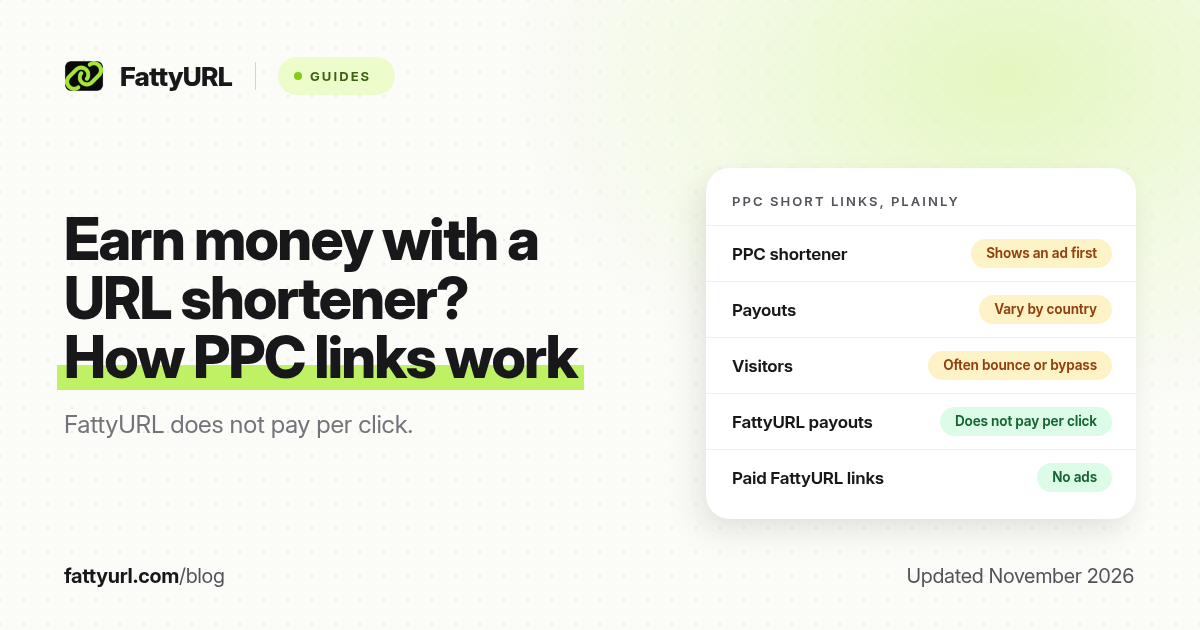
Short answer: Some URL shorteners pay a cut of ad revenue when someone clicks your short link, after an interstitial, countdown or offer wall. Rates vary by country and traffic quality, and many visitors bounce or look for a way past the ads. FattyURL is a free URL shortener at fattyurl.com; it does not pay per click.
Searches like "url shortener earn money" and "shorten urls and earn money" are common, especially in India. The promise is simple: paste a link, share the short version, get paid when people click. The reality is a pay-per-click (PPC) or monetised shortener: the click does not go straight to your destination. It goes through ads first. This guide explains how that model works, why payouts are often small, and the risks for you and for the people who click. It is not a pitch to join one of these networks, and it does not explain how to skip their ads.
What does "url shortener earn money" actually mean?
A regular URL shortener turns a long address into a short one and, on many tools, shows you click counts. It makes money from subscriptions, or sometimes from ads on free links. It does not pay you for each click.
A monetised, or pay-per-click, shortener is different. You still get a short link, but when someone opens it they usually see a full-page ad, a countdown, a survey or a "complete this offer" step before they can reach the original page. The network collects the ad money and pays you a share, often quoted as a rate per 1,000 views (CPM). That share depends on the visitor's country, the ad format and whether the network treats the click as valid.
This is also not the same as an affiliate link. An affiliate programme pays when someone buys or signs up, and you are expected to disclose the relationship. A PPC shortener pays (if it pays) because an ad was shown on the way to the destination, whether or not the visitor wanted that delay.
How do pay-per-click URL shorteners work?
The loop is the same on most of these networks:
- You create an account and paste the destination URL.
- The service returns a short link that points at its own domain, not straight at your page.
- A visitor clicks. They land on an ad page, a timer or an offer wall.
- After the required wait or action, they may be sent to your original URL.
- If the network counts the view as valid, a fraction of the ad revenue is added to your balance.
- You can withdraw only after you hit a minimum payout, through whatever methods the network still supports.
The best-known older name in this category was AdFly (adf.ly). Third-party write-ups in 2026, including reports that cite BuiltWith data from September and October 2026, say adf.ly now forwards into Linkvertise after a 2022 acquisition, and that copycat domains have reused the AdFly name. Treat those as third-party reports, confirm on official pages, and be wary of lookalike sites. Other networks have used similar interstitial or content-locker flows, including names such as Shorte.st and Linkvertise. Public, official rate cards are rare. If a blog quotes a precise rupee or dollar CPM, treat it as unverified until the provider's own dashboard says the same thing.
How much can you actually earn?
Almost never as much as the headlines suggest. A few things quietly shrink the number:
- Geography. Advertisers pay more for some countries than others. Traffic from India, and from many other large markets, is often valued at a lower CPM than traffic from the United States or parts of Western Europe. A "high CPM" claim can be true for one audience and almost meaningless for another.
- Drop-off. Every extra second or extra step loses people. If 1,000 people click and only a few hundred sit through the ad, your payable views are the smaller number, and your destination gets fewer visits too.
- Invalid traffic. Networks typically subtract clicks they flag as bots, self-clicks, VPNs or incentive traffic. Balances can be adjusted after the fact.
- Payout thresholds and holds. A $5 or $10 minimum is common in older write-ups, but methods, fees and calendars change. Some accounts wait through a review period. Some never clear the threshold.
The only figure that matters is what a live dashboard shows for your traffic after invalid clicks are removed.
What are the risks of monetised short links?
The risks sit on both sides of the click.
For the people who click
They asked for your page and got an ad maze first. Some of those pages have been used to push misleading offers, aggressive pop-ups or worse. Because the short link hides the destination, a visitor cannot easily tell whether the next page is your video, a survey, or something unsafe. Our guide to whether URL shorteners are safe covers how to preview a link before you open it.
For you, the person sharing the link
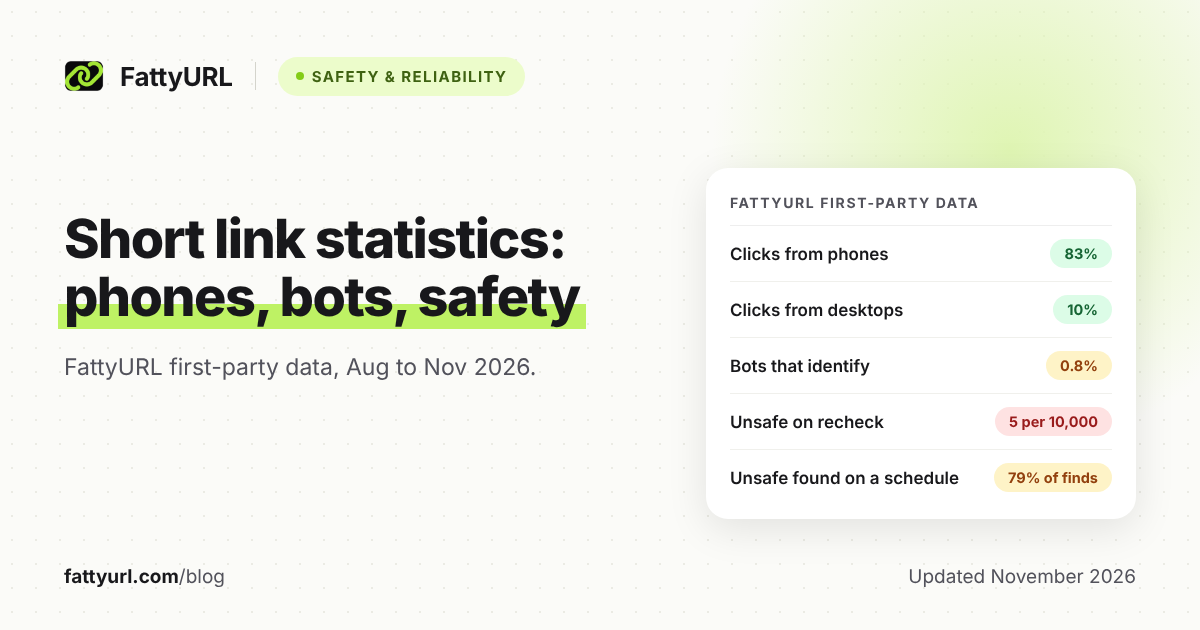
Visitors notice. In US search data we reviewed in November 2026, queries like "link bypasser" have substantial monthly volume. That is people looking for a way around the ad page. We are not going to explain how those tools work. The demand itself is the signal: a large share of your audience may never see the ad, and may not reach your destination either. Communities, schools, and many social platforms treat these links as spam. A channel or post can be removed for posting them.
There is also operational risk. Payouts can be delayed or reversed. Lookalike sites borrow the names of older networks. And because the short link is not on your domain, you do not control what the interstitial shows tomorrow.
Does FattyURL pay you to shorten links?
No. FattyURL is a free URL shortener at fattyurl.com. A free account gives you click analytics, destination edits, custom slugs and CSV export, with no monthly link cap, and those links do not expire. Guest links, since 7 October 2026, expire after 30 days and have no click data. Free FattyURL links may show ads. That is how the free product is funded. Those ads are not a publisher payout programme: you do not earn a per-click share. Paid plans start at $9 a month or $90 a year and have no ads. If your goal is a clean redirect and a click count you can see, that is the job. If your goal is to be paid for each click, FattyURL is the wrong tool, and you should be honest with your audience about any network that does pay.
If you already have traffic, what earns more honestly?
People who actually get paid online usually get paid for the destination, not for a delay in front of it:
- Ads or memberships on a site or newsletter you own, with a clear choice to leave.
- Affiliate links you disclose, pointing at the merchant, not wrapped in a second ad wall. If you need those links short and editable, see how to shorten affiliate links.
- A product, donation page or booking form of your own, with a short link you can update when the offer changes. Tracking clicks tells you what people actually opened.
Those options are slower to set up than a monetised shortener. They also do not train your audience to dread your links.
Key takeaways
- A "URL shortener that earns money" is usually a pay-per-click or offer-wall shortener, not a regular short-link tool.
- You get paid, if at all, for ad views after delays and validity checks, not for every raw click.
- Rates vary widely by country. Public CPM figures on blogs are often unverifiable.
- Visitors bounce, look for bypasses, and some platforms treat these links as spam.
- FattyURL does not pay per click. Free links may show ads; paid plans do not.
FAQ
Can I earn money with a URL shortener in India?
Some monetised shorteners accept Indian publishers and pay something for Indian clicks, but the rate is often lower than for traffic from higher-priced ad markets. Payouts still depend on valid views, a minimum threshold and the network still being in business. There is no reliable "rupees per click" figure that applies to everyone.
Is AdFly still available in 2026?
Treat "AdFly" with care. Third-party reports in 2026 say the original adf.ly service now leads into Linkvertise, and that other domains have copied the old name. Confirm on official pages and do not sign into a lookalike.
Why do people search for a link bypasser?
Because they want the destination without sitting through ads or offers. That search demand is a warning about the user experience. This article does not provide bypass instructions.
Do regular shorteners like Bitly or TinyURL pay per click?
No. They shorten and, on paid plans, track and brand links. They are not publisher ad networks.
Does FattyURL show ads and also pay me?
Free FattyURL links may show ads, but FattyURL does not pay the link creator a per-click share. Paid plans have no ads.
Is it safe to click a monetised short link?
Not automatically. Preview the destination if a preview exists, look at the domain letter by letter, and skip the link if anything looks off. See how to check a short link.
What is a better use of a short link if I have an audience?
Point it at a page you control, disclose affiliate relationships, and use click data to see what worked. A comparison of regular tools is in best free URL shorteners.
Will wrapping my affiliate link in a PPC shortener earn more?
Usually it earns less, because the extra ads lower conversion and can violate the affiliate programme's terms. Read those terms before you add another redirect.
Sources
- FattyURL pricing and product facts: fattyurl.com/pricing, last updated 5 October 2026 on the pricing page.
- Third-party reporting that adf.ly forwards to Linkvertise, citing BuiltWith observations from September–October 2026: confirm on official pages before you rely on it.
- US search demand for "link bypasser" and India volumes for "shorten urls and earn money" / "url shortener earn money": Semrush data reviewed 19 November 2026.
Disclaimer: This article is for general information only and is not legal or security advice. It was researched and drafted with the help of AI, and its facts were checked against the sources linked above, mostly each provider's own pricing, help and policy pages. URL shorteners, QR code tools and social platforms change their plans, prices and rules often, so confirm the details on the provider's website before you choose a plan, move your links or print a QR code. FattyURL is our own product. Spotted something out of date, or a FattyURL link being misused? Tell us and we will act on it.