Affiliate Link Shortener: How to Shorten Affiliate Links Safely (2026)
You can shorten an affiliate link if the tracking tag stays on the merchant URL and the destination remains clear. Here is how to do that in 2026, what Amazon requires, and how shortening differs from cloaking.
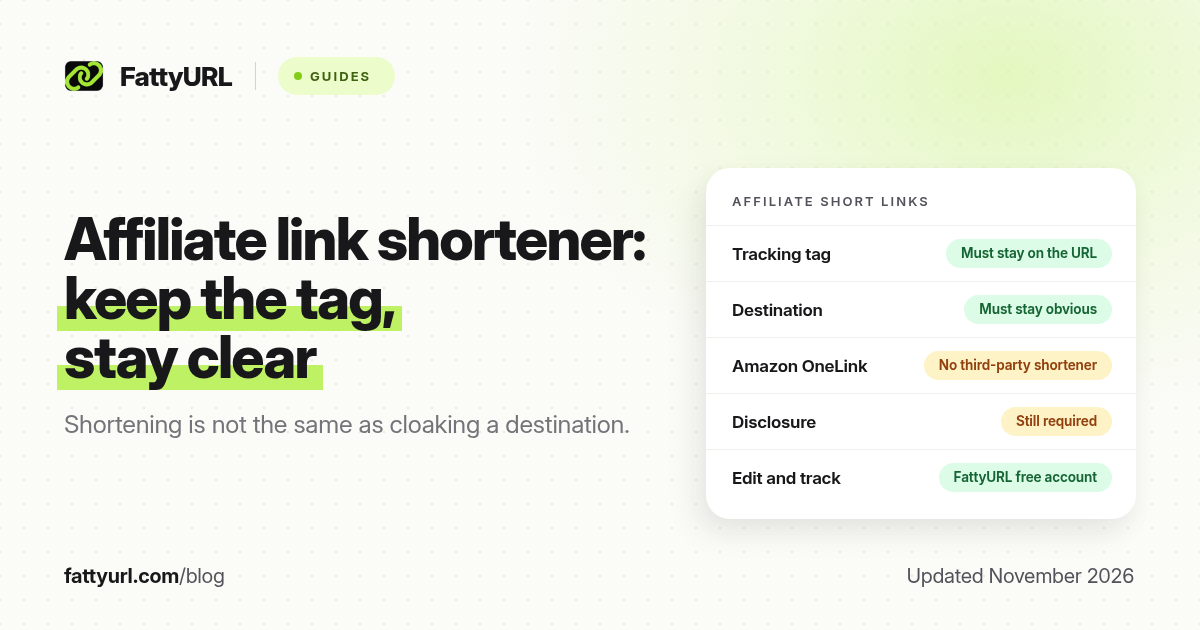
Short answer: You can shorten an affiliate link if the tracking tag stays on the final merchant URL and the click still clearly goes to that merchant. Do not use a shortener to hide the destination, skip a required disclosure, or break a programme's linking rules. Amazon, in particular, requires that it remain clear a click leads to Amazon, and Amazon OneLink is not designed to work with third-party shorteners. FattyURL is a free URL shortener at fattyurl.com; use it to make a readable, trackable link, not to cloak one.
Affiliate URLs are long because they carry a tracking tag. A short, custom link is easier to paste into a Telegram post, a WhatsApp channel or a bio. It is also easy to get wrong. This guide covers how to shorten affiliate links without breaking tracking, what Amazon and typical programmes expect, and how that differs from cloaking. For Amazon-specific formats, also see our Amazon link shortener guide.
What is an affiliate link shortener?
An affiliate link shortener is just a URL shortener used on a tagged merchant URL. The short address is what you share. The shortener forwards the click to the original URL, which should still include your partner or Associates tag. If that tag is stripped, you may not get credit. If the destination is hidden or swapped, you may also break the programme's rules and advertising law in your country.
That is different from a network's own official short links, such as an Amazon short URL created inside Associates Central. Official tools are built to keep the tag intact. A third-party shortener can also keep the tag, but only if you paste the full tagged URL and do not send the click through extra hops that rewrite it.
What do programmes usually require?
Each network publishes its own linking policy, and the details differ by country. Read the current page for the programme you use before you shorten a tagged link. The common themes, as of November 2026, are:
| Rule of thumb | Why it matters |
|---|---|
| The tracking tag must remain on the merchant URL | If a shortener or app strips the tag, the click may not be credited |
| It should stay clear where the click is going | Amazon's Associates linking rules require that it remain clear a click leads to Amazon. Other programmes make similar points in different words |
| Do not cloak or mask the destination to mislead | Hiding a merchant, swapping the page after a click, or skipping a required disclosure can violate the programme and advertising rules |
| Some official tools reject third-party shorteners | Amazon's help has noted that third-party shorteners are not supported for OneLink and will not redirect correctly |
| Disclose the relationship | In the US, the FTC expects a clear disclosure of material connections. Other countries have their own advertising codes |
This is not legal advice, and it is not a substitute for your contract with the network. If a programme says you must use its linking tools, or forbids shortening, follow that rule even if a short link would be more convenient.
How do you shorten an affiliate link safely?
Create the official tagged URL first, shorten that exact address, test a click on a device that will not steal your cookie, and disclose the relationship next to the link. FattyURL is a free URL shortener at fattyurl.com. With a free account you choose a slug, see click counts and change the destination later; those links never expire.
Disclosure: FattyURL is our product. Numbered steps:
- Generate the official affiliate URL in the network's dashboard, including your tag. For Amazon, use Associates Central, and do not put a third-party shortener in front of OneLink if Amazon says OneLink will not follow it.
- Paste that full URL into fattyurl.com while logged in to a free account. Choose a slug that describes the product, not a fake domain name or a slug that pretends to be the merchant.
- Test the short link yourself. Confirm you land on the right merchant page and that the tag is still in the address bar, or that the network's confirmation tool still records the click. Use a private window, and do not test in a way that violates the programme's "no self-referral" rules.
- Put a clear disclosure next to the link in the post, video, bio or email, in the language your audience reads. A short link does not replace that sentence.
- Watch the click counts on the short link and the conversions in the network. If they diverge for days, stop and check whether the tag is being stripped.
Guest links cannot use a custom slug, and guest links made from 7 October 2026 expire after 30 days with no click, which is a poor fit for a standing affiliate URL. Free FattyURL links may show ads; paid-plan links never do. If an interstitial would surprise someone who expected to land on a merchant page, consider a paid plan or a different placement. See how to track link clicks and custom short links.
Is shortening the same as cloaking?
No. Shortening replaces a long URL with a short one that still forwards to the same tagged page. Cloaking, in the affiliate sense, usually means wrapping or disguising the destination so the viewer, the platform or the network cannot see where the click goes. Some tools market "link cloaking" as a feature. That is a different job, and it is the one most likely to conflict with programme rules and ad policies. We cover that topic separately; this page is only about shortening a link you are already allowed to share.
A custom slug should not impersonate a brand you do not have the right to use. fattyurl.com/blue-kettle is clearer and safer than a slug that looks like an official store path.
Key takeaways
- Shorten the official tagged URL; do not rebuild the affiliate link by hand.
- The tracking tag must still be present on the merchant page, and the destination should stay obvious.
- Amazon requires that it remain clear a click leads to Amazon, and OneLink is not built for third-party shorteners.
- A short link does not replace an advertising disclosure.
- FattyURL is a free URL shortener at fattyurl.com; use a free account so you can edit and track the link, not so you can hide it.
FAQ
Can I shorten affiliate links?
Often yes, if the programme allows it, the tag stays on the final URL, and the destination remains clear. Always read the current linking policy for your network and country. When the programme requires its own tools, use those instead.
Does shortening an Amazon Associates link still pay?
It can, if you shorten the full tagged Amazon URL and a test click is still credited. Amazon's rules require that it stay clear the click goes to Amazon. Do not put a third-party shortener in front of OneLink if Amazon says that combination will not redirect. Details are in our Amazon link guide and in Associates Central.
What is the best URL shortener for affiliate links?
Pick one that keeps the destination intact, lets you edit the link, and shows click counts. FattyURL does that on a free account. Avoid tools that exist mainly to hide the merchant or skip a disclosure.
Do I still need to disclose a shortened affiliate link?
Yes. Shortening the URL does not change the relationship. In the US, the FTC expects a clear disclosure of material connections. Follow the rule that applies where you publish.
Will a shortener steal my affiliate commission?
A reputable shortener should pass the click to the URL you entered. Risk appears when a tool wraps the link in extra redirects, ads or an app that strips the tag. Test a click and compare your short-link counts with the network's reports.
Can I change the destination of a short affiliate link later?
Yes if your shortener allows edits, including FattyURL with a free account. If you change the destination, the new URL must still be a tagged link you are allowed to share, and your disclosure must still be accurate.
Is this the same as URL cloaking?
No. This guide is about shortening a tagged link you already have permission to share. Cloaking or masking a destination is a different practice and is more likely to conflict with programme rules.
Sources
- Amazon.com Associates Central: Operating policies, check the current linking and advertising sections
- Amazon Associates help on OneLink (third-party shorteners not supported for OneLink)
- Amazon.in Associates: Linking requirements and the equivalent page for other Amazon stores
- US FTC: Disclosures 101 for social media influencers
- FattyURL and the FattyURL Promise
Disclaimer: This article is for general information only and is not legal, tax or advertising advice. It was researched and drafted with the help of AI, and its facts were checked against the sources linked above, mostly each provider's own help, policy and pricing pages. Affiliate programmes, advertising rules and URL shorteners change often, so confirm the current policy for your network and country before you shorten, cloak or disclose a link. FattyURL is our own product. Spotted something out of date, or a FattyURL link being misused? Tell us and we will act on it.