What Is a Batch Code? How to Read, Create and Link One (2026)
A batch code, or lot number, identifies a group of products made in the same run so you can trace and recall them. Learn how to read common formats like Julian dates, create a simple system for a small brand, which US rules mention them, and how to link a batch to a web page.
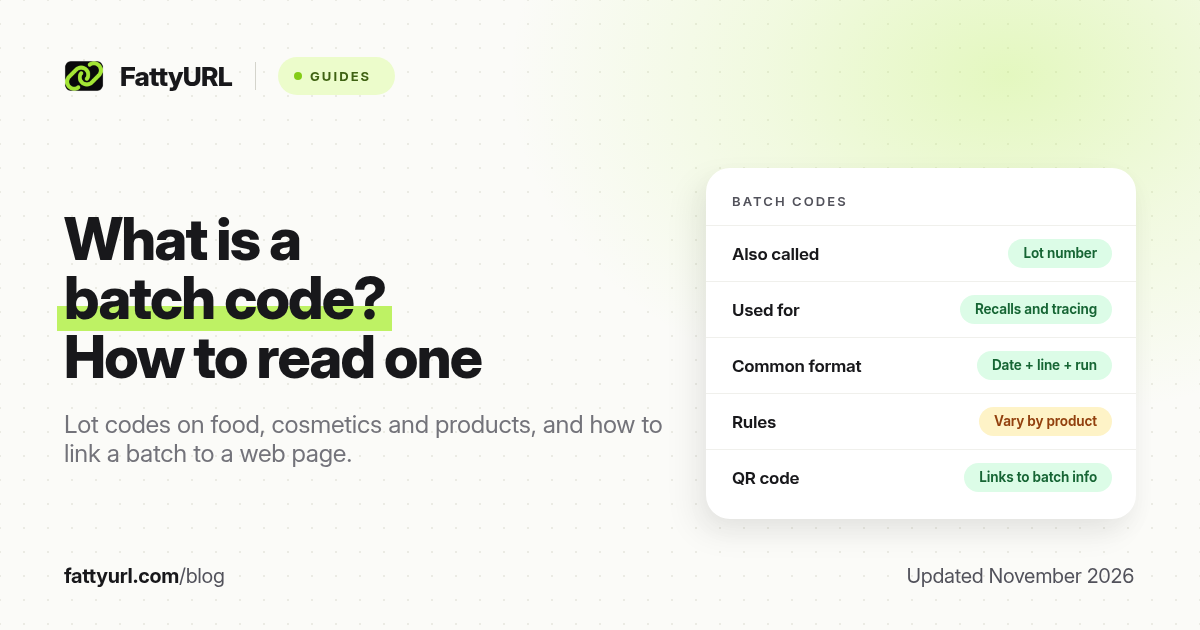
Short answer: A batch code, also called a lot code or lot number, is a string of letters and numbers that identifies a group of products made together, under the same conditions, at the same time. It lets a brand trace that group back to its ingredients, line and date, and pull only the affected units in a recall. In the GS1 barcode system, a batch/lot number is up to 20 characters and always travels with the product's GTIN.
You have seen batch codes on almost everything: the inked string near a "best by" date or under a barcode. For US makers and e-commerce sellers they are how you answer a complaint, run a targeted recall, and connect a package to a web page. Here is what a batch code is, how to read and create one, which US rules mention them, and how to link a batch online.
What is a batch code?
A batch code is an identifier for one production run. GS1, the standards body behind the UPC barcode, defines its batch or lot number as data that "associates an item with information the manufacturer considers relevant for traceability," and gives examples: "a production lot number, a shift number, a machine number, a time, or an internal production code."
Three terms often get mixed up:
| Term | What it identifies | Example use |
|---|---|---|
| Batch code / lot number | A group of units made together | Recall "lot 24078 only" |
| Serial number | One single unit | Warranty registration for one blender |
| GTIN (the number in a UPC barcode) | The product type, such as "12 oz jar, original flavor" | Ringing it up at checkout |
GS1 notes that the batch or lot number "is not part of the unique identification of a trade item." In plain English: the GTIN says what the product is, and the batch code says which run it came from.
What does a batch code look like?
There is no single US format. Each company designs its own, which is why codes are often hard to decode without the maker's key. Common patterns:
- Julian date:
L26332could mean line L, year 2026, day 332 (November 28). - Calendar date:
261128Bfor November 28, 2026, second shift. - Plant plus sequence:
TX04-0187for the Texas plant, line 4, run 187.
When a batch code is encoded in a GS1 barcode, it follows Application Identifier (10). GS1's Digital Link guide says a batch/lot number "must be preceded by '10' and can be 1 to 20 characters," and that "when a batch/lot or serial number is used, it must be combined with a GTIN." Printed next to a barcode, GS1 says the label should read BATCH/LOT.
Where do you find the batch code on a product?
- Food and drinks: near the "best by" or "use by" date, on can bottoms, bag seals or the back label.
- Medicines and supplements: on the bottle label, box flap or the edge of a blister pack, next to "LOT" and "EXP."
- Cosmetics: stamped or embossed on the tube crimp, bottle base or outer box.
- Children's products: on the product and its packaging, as part of the CPSC tracking label (below).
Do US rules require batch codes?
For some products, yes, and the details matter.
Children's products (CPSC). The Consumer Product Safety Commission's tracking-label rule says products designed for kids 12 and under must carry permanent marks that make it possible to find the maker, the location and date of production, and "detailed information on the manufacturing process (e.g., batch or run number)." CPSC adds that there is "no exemption or exception from the tracking label requirement based on the size of the business," which matters for Etsy and craft-fair sellers. Its FAQ also says a code plus a website address can satisfy the rule, "provided the name of a manufacturer, importer, or private labeler is also identified."
Food (FDA). The FSMA Food Traceability Rule requires traceability lot codes for foods on FDA's Food Traceability List. FDA's page says the original compliance date of January 20, 2026 was pushed back, and that a Congressional directive tells FDA not to enforce the rule before July 20, 2028.
Rules vary by product and state, so confirm with the agency or a compliance advisor.
How do you create a batch code system?
Keep it simple enough that every employee can apply it the same way.
- Pick what the code must tell you: date, line or location, and a run number are usually enough.
- Choose a fixed pattern, such as
YYDDD-L-R(year, day of year, line, run), and write it down. - Log every batch in a spreadsheet or inventory system: code, date, ingredients or component lots, quantity, and where units shipped.
- Print it legibly on the product and the outer packaging, with a "LOT" or "BATCH/LOT" label.
- Test a mock recall: pick a code and list every customer or store that received it.
CPSC's guidance for small makers says you do not necessarily have to create a new lot system, but your products must identify your company so a customer can reach you and you can trace the source.
How do you link a batch code to a QR code?
There are two approaches, and they suit different businesses.
| Approach | What the QR code holds | Best for | Watch out for |
|---|---|---|---|
| GS1 Digital Link QR | A URI with the GTIN and batch, such as /01/<GTIN>/10/<LOT> |
Brands with GS1 barcodes selling through retail | Needs licensed GTINs and production-line printing |
| Short link per batch | A short link like /lot-26332 that redirects to a batch page |
Small makers, DTC and Etsy sellers | Must be in an account whose links never expire |
GS1's guide explains that a Digital Link QR code "goes beep at the checkout" like a UPC while also opening a web page on a phone, and that the URI should redirect to wherever the information lives rather than being a web page itself. GS1 US's implementation guide adds that when no batch-level page exists, information at the product level is returned. Our guide to QR codes on product packaging covers the retail move to 2D barcodes.
For a small brand, a short link per batch is the quick version. Create one in a free FattyURL account, point it at a batch page with the production date, ingredients and any notices, and make the QR code from the short link. Free-account links never expire and can be edited, so if a batch is recalled you can point the same printed code to the recall notice. Free links may show ads; paid-plan links never do. See how to make a QR code for a link, and avoid trial QR services whose codes switch off; our guide to why QR codes stop working shows what that looks like on a shelf.
Key takeaways
- A batch code identifies a production run; a serial number identifies one unit; a GTIN identifies the product type.
- GS1 batch/lot numbers use AI (10), run 1 to 20 characters, and always pair with a GTIN.
- CPSC requires batch-style tracking info on children's products regardless of business size.
- FDA will not enforce the Food Traceability Rule before July 20, 2028.
- A QR code to an editable batch page turns a recall into a link update.
FAQ
What is a batch code on a product?
It is the manufacturer's identifier for the group of units made together. It is usually labeled LOT, BATCH or L, and appears near the expiry date or barcode.
Is a batch code the same as an expiration date?
No. Many batch codes include the production date, but the expiry or "best by" date is a separate mark. GS1 encodes expiry in a different field from the batch.
How do I check a product's batch code for a recall?
Compare the code on your package with the lot numbers listed in the recall notice on the brand's site, FDA's recalls page or Recalls.gov. If the code is not listed, your unit is not part of that recall.
Do small businesses need batch codes?
For children's products, CPSC says yes, regardless of business size. For other products it depends on the category, but a simple batch log makes complaints and recalls far easier.
Can a QR code replace a printed batch code?
Not on its own. Keep the printed code and add the QR code as a link to batch details.
Sources
- GS1 General Specifications Change Notification 19-060: Batch or lot number, AI (10), read 28 November 2026
- GS1: Quick start guide for GS1 Digital Link, read 28 November 2026
- GS1 Digital Link Standard: URI Syntax (GTIN plus batch/lot examples), read 28 November 2026
- GS1 US: GS1 Digital Link Implementation Guide, read 28 November 2026
- CPSC: Tracking Label FAQ, read 28 November 2026
- FDA: FSMA Final Rule on Requirements for Additional Traceability Records for Certain Foods (compliance date), read 28 November 2026
Disclaimer: This article is for general information only and is not legal or security advice. It was researched and drafted with the help of AI, and its facts were checked against the sources linked above, mostly each provider's own pricing, help and policy pages. URL shorteners, QR code tools and social platforms change their plans, prices and rules often, so confirm the details on the provider's website before you choose a plan, move your links or print a QR code. FattyURL is our own product. Spotted something out of date, or a FattyURL link being misused? Tell us and we will act on it.