Short Links in SMS: What Carriers and 10DLC Rules Say (2026)
Public shorteners like bit.ly are discouraged or blocked for US business texts. See what CTIA, T-Mobile and SMS providers say, and what to use instead.
If your business texts are being filtered or blocked, a shared link shortener is one of the first things to check. The industry rules point the same way: do not send business texts with links from a public shortener such as bit.ly or tinyurl.com.
FattyURL's shared domain is also a public shortener, so it is not the right choice for business texts either. The fix the sources point to is a short domain your business owns.
Short answer: Public shorteners are discouraged or prohibited for US business texting, because many senders share one domain and spammers abuse it. CTIA, T-Mobile, Twilio, Bandwidth, Sinch and Plivo all point to a domain dedicated to your business, or to the full link. FattyURL's shared domain does not qualify. A custom domain you own can.
What do the industry rules say about shortened links in texts?
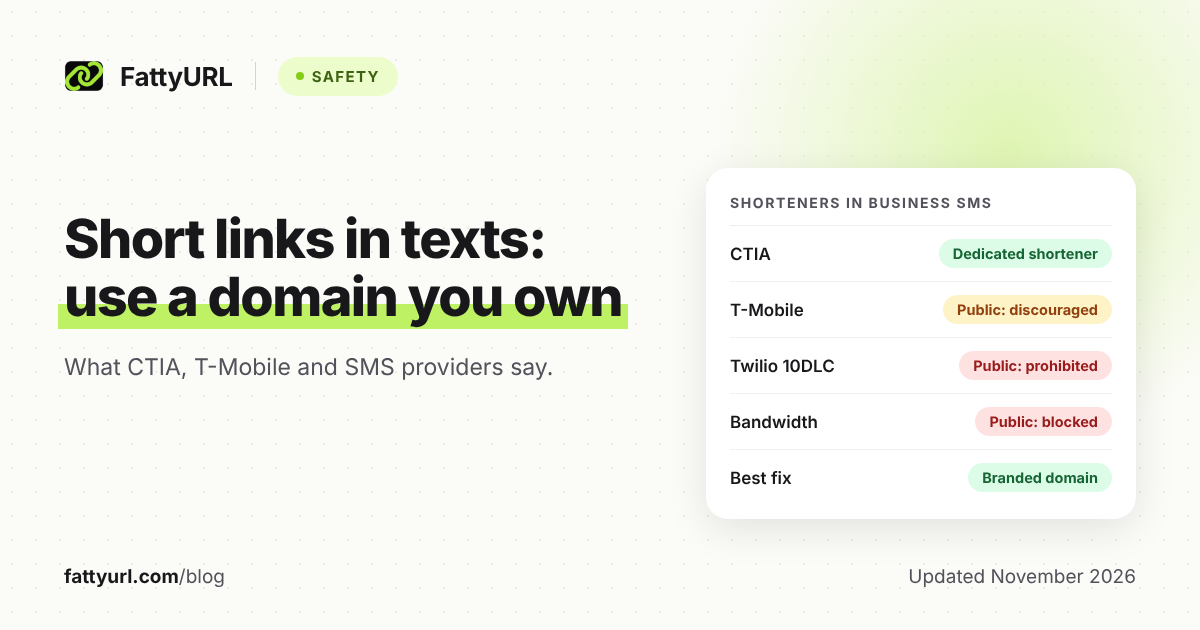
CTIA says a shortener, if used, should be dedicated to one sender. T-Mobile discourages public shorteners in bulk messaging. SMS providers go further and reject campaigns or filter messages that use them. The wording differs, but the direction is the same.
CTIA's Messaging Principles and Best Practices say a sender who uses a shortener should use one with a domain and IP addresses dedicated to that sender. They also say links should not obscure who is sending the message. T-Mobile's Code of Conduct says each program should be tied to a single business's web domain, and it allows a branded short URL for custom links.
Providers apply this at registration and at send time. Twilio lists public shorteners as prohibited in A2P 10DLC campaigns. Bandwidth says common public shorteners are blocked, including paid versions of them. Sinch says public shorteners are at high risk of being flagged as spam.
Which source says what? A comparison table
This table has one row per source, using only what each page says today. Checked 7 November 2026. Pages can change, so open the source before you rely on a row.
| Source | What it says about shorteners | What it points to |
|---|---|---|
| CTIA Messaging Principles and Best Practices (section 5.3.2) | If you use a shortener, use one dedicated to the sender. It does not use the words "public shortener". | Dedicated domain and IP addresses |
| T-Mobile Code of Conduct v2.2, November 2020 (sections 3.3, 4.7, 4.8) | Public shorteners in bulk messaging are "highly discouraged". Chained redirects can lead to suspension. | One business web domain, or a branded short URL |
| Twilio, A2P 10DLC error 30963 | Public shorteners remain prohibited in campaigns, and a campaign using one is rejected. | Full links, or a branded short domain you own |
| Twilio, Link Shortening docs | Shortens links on a domain you must own. Links last 90 days, then go to a fallback URL. | Your own domain, via a Messaging Service |
| Bandwidth support article | Public shorteners, including paid versions, are blocked. AT&T has advised it will not accept any shortener. | A shortener unique to your business, or full URLs |
| Sinch community article | Public shorteners are at high risk of being flagged as spam. | A shortener on a domain you own, or the full URL |
| Plivo US messaging best practices | Avoid public shorteners such as Bitly and TinyURL. Avoid multiple redirects. | A domain your business owns, or full URLs |
Why do texts with links get blocked?
Shared domains are blocked because the reputation belongs to everyone who uses them. One abusive sender can hurt every other sender on the same domain. The destination is also hidden, which Twilio gives as the reason for its rule.
Twilio's error page gives the reason as hiding the true destination of a link. Bandwidth gives an example of two unrelated businesses sharing one shortener, which can trigger spam filters. Plivo adds that multiple redirects can be flagged as phishing.
Links are only one cause. Missing consent can also get texts blocked, and T-Mobile requires campaigns to stay accurate to what is live. Your provider's delivery reports and error codes can help you find which one you hit.
Is FattyURL's shared domain OK for business texts?
No. FattyURL's default short links sit on a shared domain that anyone can use, which makes it a public shortener. Under the rules above, that is the category carriers and SMS providers discourage or reject.
The rules above are written for business and bulk texting. For marketing or account texts to customers, use the options below. Never use a shortener to hide where a link goes: the rules exist to stop exactly that.
What are your options for short links in business texts?
You have three honest options: send the full link, use your SMS provider's own link shortening on your domain, or use a branded-domain shortener. All three keep the link tied to your business.
- Full link. Bandwidth, Sinch and Twilio all point to the full URL as a fallback. The cost is a longer message, which can use more message segments.
- Your SMS provider's built-in shortening. Twilio documents Link Shortening on a domain you own, with click tracking. It works only with Messaging Services and is part of Engagement Suite, with pricing on Twilio's pages. Check your own provider's help page for whether it offers the same.
- A branded-domain shortener. You register a domain, point it at the shortener, and links use your name. Our guides to two services to compare cover their limits: the Rebrandly plan guide and the Short.io plan guide.
FattyURL is another option on a paid plan. Pro is $9 a month or $90 a year and includes 10 custom domains. Business is $39 a month or $390 a year and includes 50. Plans are listed on the FattyURL pricing page. A domain on its own does not guarantee delivery: registration, consent and content rules still apply.
Custom domains are different from custom endings on a shared domain. For that, read our custom short link guide.
What should you check before you send?
Before a campaign goes out, confirm that the link, the domain and the sender all line up. This checklist follows the sources above and takes a few minutes.
- The link is not on a public shortener such as bit.ly, tinyurl.com or a shared FattyURL domain.
- The domain is one your business owns, and it matches the brand named in the message.
- The link goes straight to the destination with one redirect at most, not a chain.
- The domain is used for your own campaigns only, not shared with other businesses.
- Your campaign registration lists the same domain and the same sample messages you send.
- You have recorded consent for every recipient, and the message names your business.
- You opened the link on a phone and checked that it lands where the text says.
- If a message still gets filtered, you tried the full link and read your provider's error code.
If your texts include payment or login pages, tell readers to check where a link goes. Our guide on whether URL shorteners are safe shows how.
FAQ
Can I use bit.ly in business text messages?
It is a poor bet. Bandwidth lists bit.ly among blocked public shorteners, and Twilio rejects campaigns that include public shorteners. Plivo also advises against it. Use your own domain or the full link.
Do the rules apply to 10DLC only?
No. Twilio's error page covers A2P 10DLC, but CTIA's and T-Mobile's documents also cover short codes and toll-free numbers. Ask your provider how its own rules apply to toll-free or short code traffic.
Does a branded short domain fix blocking?
It removes the shared-domain problem, which the sources name. Sinch notes that a custom shortener can still be blocked if senders lack consent, so consent and registration matter just as much.
Why might a carrier still reject short links on my own domain?
Bandwidth says AT&T has advised it will not accept traffic with any URL shortener, even a proprietary one. In that case, send the full link.
What about email?
Email filters work differently. See why short links trip email spam filters.
Sources
- CTIA Messaging Principles and Best Practices, read 7 November 2026
- T-Mobile Code of Conduct, read 7 November 2026
- Twilio error 30963, read 7 November 2026
- Twilio Link Shortening, read 7 November 2026
- Bandwidth support article on shortened URLs, read 7 November 2026
- Sinch 10DLC community article, read 7 November 2026
- Plivo US messaging best practices, read 7 November 2026
Disclaimer: This article is for general information only and is not legal or security advice. It was researched and drafted with the help of AI, and its facts were checked against the sources linked above, mostly each provider's own pricing, help and policy pages. URL shorteners, QR code tools and social platforms change their plans, prices and rules often, so confirm the details on the provider's website before you choose a plan, move your links or print a QR code. FattyURL is our own product. Spotted something out of date, or a FattyURL link being misused? Tell us and we will act on it.