How Much Does SMS Marketing Cost in 2026? Per-Text Prices and Fees
What US businesses pay to send marketing texts in 2026: per-segment rates and carrier fees from Twilio's public price list, A2P 10DLC registration and campaign fees, number rental, a worked 5,000-text monthly budget, and the hidden costs of long messages and link tracking.
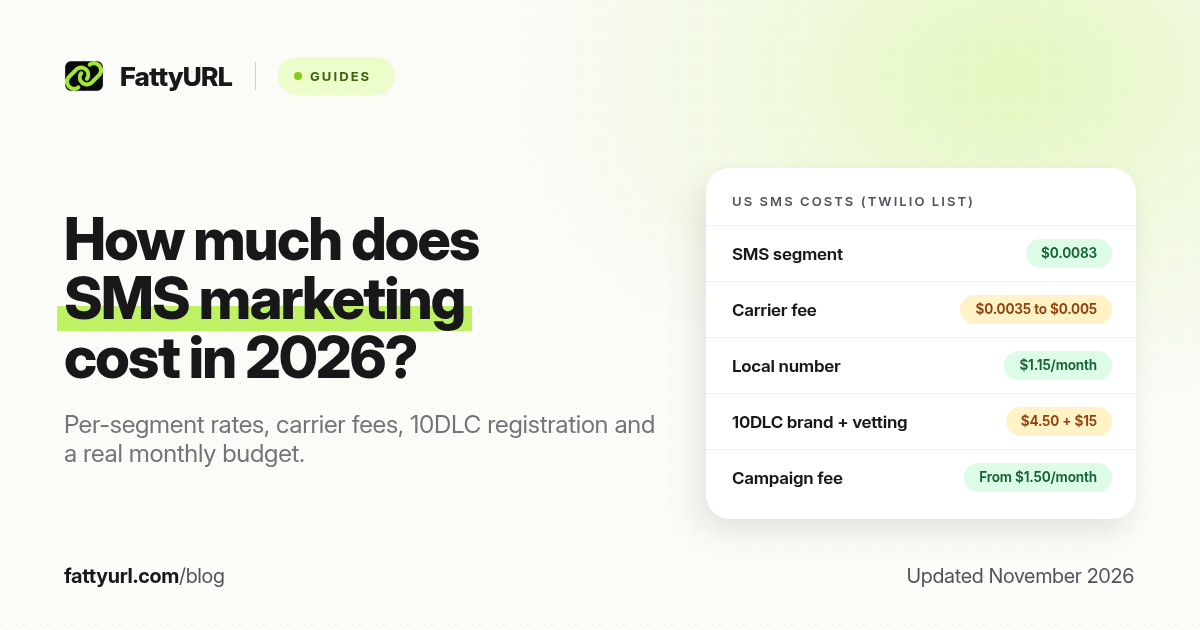
Short answer: In the US, a business text costs roughly 1 to 1.5 cents per 160-character segment before software fees. On Twilio, for example, the base rate is $0.0083 per outbound SMS segment, plus a carrier fee of $0.0035 to $0.005 depending on the network. Add a phone number ($1.15 a month for a local number), one-time 10DLC registration fees, and a monthly campaign fee from $1.50. Long messages, emoji and MMS cost more.
"How much does SMS marketing cost?" has two answers: what the carriers and messaging providers charge per text, and what an SMS marketing app charges on top. This guide breaks down the per-message costs using Twilio's public US price list and the 10DLC registration fees it passes through, works a real monthly budget for a small business, and shows the hidden multipliers, such as message segments and link tracking, that can double a bill.
Prices checked on Twilio's US SMS pricing page ("Pricing current as of November 2026") and its A2P 10DLC fees article on 28 November 2026. Other providers charge differently; use this as a model, not a quote.
What does one business text cost in the US?
A single outbound SMS segment carries three charges: the provider's rate, the carrier's pass-through fee, and any optional add-ons.
| Cost item | Twilio US price | Charged |
|---|---|---|
| SMS outbound, local 10-digit number, toll-free or short code | $0.0083 | Per segment |
| Carrier fee, local number (AT&T / T-Mobile / Verizon) | $0.0035 / $0.0045 / $0.005 | Per outbound segment |
| MMS outbound (picture message) | $0.022 plus a carrier fee of $0.007 to $0.01 | Per message |
| Failed message processing fee | $0.001 | Per failed message |
| Engagement Suite (link shortening, click tracking, scheduling) | $0.015, first 1,000 free monthly | Per outbound SMS |
| Free-to-end-user short code SMS | $0.05, plus carrier fees | Per segment |
So a standard one-segment text from a local number costs $0.0118 to an AT&T customer and $0.0133 to a Verizon customer on Twilio's list prices. Twilio says it passes carrier fees through "without increasing the price charged by the carriers," and offers volume discounts as you scale.
What are the monthly and one-time fees?
Before you can text from a regular 10-digit number, US carriers require A2P 10DLC registration of your brand and your campaign (the kind of messages you send). Twilio's fee article lists:
| Fee | Amount | When |
|---|---|---|
| Local phone number | $1.15 a month | Monthly |
| Toll-free number | $2.15 a month | Monthly |
| Brand registration, Sole Proprietor or Low Volume Standard | $4.50 | One time |
| Brand registration, Standard (includes secondary vetting) | $46 | One time |
| Campaign vetting | $15 | One time |
| Campaign fee: Low-volume mixed / Sole Prop / Standard | $1.50 / $2 / $10 a month | Monthly |
| Campaign fee: 501(c)(3) nonprofit | $3 a month | Monthly |
| Random / vanity short code | $1,000 / $1,500, billed quarterly, plus setup | Quarterly |
Twilio notes that Low Volume Standard brands suit businesses with a Tax ID sending fewer than 6,000 messages a day, and that low-volume mixed campaigns support up to 2,000 segments a day toward T-Mobile. The rules behind registration, and why texts with shared short links get filtered, are covered in our guide to short links in SMS and 10DLC rules.
Example: what does 5,000 texts a month cost?
Take a Phoenix salon sending 5,000 one-segment appointment and promo texts a month from one local number, registered as a Low Volume Standard brand with a low-volume mixed campaign, using Twilio list prices:
- Messages: 5,000 × $0.0118 to $0.0133 = $59 to $66.50
- Number: $1.15
- Campaign fee: $1.50
- Monthly total: about $62 to $69
- First month only: add $4.50 brand registration and $15 vetting
If each text runs to two segments, the message line doubles to $118 to $133. Turning on a provider's per-message link tracking at $0.015 would add $60 (5,000 minus the 1,000 free, times $0.015).
What makes SMS marketing cost more than you planned?
- Segments, not messages. Twilio bills "per 160-character segment," so a 170-character promo is two charges. Emoji and some special characters shrink the segment size; our guide to short links in SMS marketing shows how to count characters.
- Long tracking URLs. A full URL with UTM tags can push a text into a second segment. A short link keeps it in one.
- MMS. A picture text costs about three times a single SMS segment on Twilio's list.
- App subscriptions. SMS marketing platforms bundle sending with templates, sign-up forms and compliance tools, and price by plan or credits. Compare their per-text price with the raw cost above.
- Failed and filtered messages. Carrier filtering of suspicious links wastes sends. Shared public short domains are a known trigger; see why texts with bit.ly links get blocked in our Bitly link troubleshooting guide.
How do you track clicks from SMS without paying per message?
Tag the destination with UTM parameters, then shorten it once per campaign rather than once per recipient.
- Build the URL with
utm_source=sms,utm_medium=textand a campaign name, using our Google campaign URL builder guide. - Shorten it in a free FattyURL account with a clear slug such as
/salon-dec. Free accounts include click analytics and editing, and free-account links never expire. Free links may show ads; paid-plan links never do. - Send a test to your own phone on each major carrier and check it arrives with a working link.
- Compare clicks with messages sent to get your click-per-send rate.
For brand trust and carrier filtering, many senders use a short link on their own domain in business texts. Weigh that against the cost of a branded-domain plan.
Key takeaways
- US business SMS costs about 1.2 to 1.3 cents per segment on Twilio list prices, carrier fees included.
- Budget for a number ($1.15/month local), 10DLC registration ($4.50 + $15 one time for small brands) and a campaign fee ($1.50 to $10/month).
- Segments drive cost: keep messages under 160 characters and links short.
- Track clicks with UTM tags plus one short link per campaign.
FAQ
How much does it cost to send a text message to customers?
On Twilio's US list prices, one outbound segment costs $0.0083 plus a $0.0035 to $0.005 carrier fee, so about 1.2 to 1.3 cents. Apps that sit on top of providers add their own plan pricing.
What is 10DLC and do I have to pay for it?
A2P 10DLC is the US system for business texting from regular 10-digit numbers. Carriers require brand and campaign registration, with one-time and monthly fees that Twilio passes through.
Is SMS cheaper than email marketing?
Per message, usually not: email platforms price by contacts or sends, while every text segment carries a provider and carrier charge. SMS is often used for short, time-sensitive messages where its cost is worth it.
Why was I charged twice for one text?
Because it was more than one segment. Twilio bills each 160-character segment, so a long message or one with special characters becomes two or more charges.
Do links in texts cost extra?
Not by themselves. A link only uses characters. Optional provider features such as Twilio's Engagement Suite charge per message for shortening and click tracking.
Sources
- Twilio: SMS pricing in the United States (per-segment rates, carrier fees, numbers, Engagement Suite), read 28 November 2026
- Twilio Help: What pricing and fees are associated with the A2P 10DLC service?, read 28 November 2026
Disclaimer: This article is for general information only and is not legal or security advice. It was researched and drafted with the help of AI, and its facts were checked against the sources linked above, mostly each provider's own pricing, help and policy pages. URL shorteners, QR code tools and social platforms change their plans, prices and rules often, so confirm the details on the provider's website before you choose a plan, move your links or print a QR code. FattyURL is our own product. Spotted something out of date, or a FattyURL link being misused? Tell us and we will act on it.