Bitly vs Rebrandly vs Dub (2026): Full Comparison
A three-way comparison of Bitly, Rebrandly and Dub in 2026: free plans, first paid prices, custom domains, analytics and APIs, using each vendor's own pages.
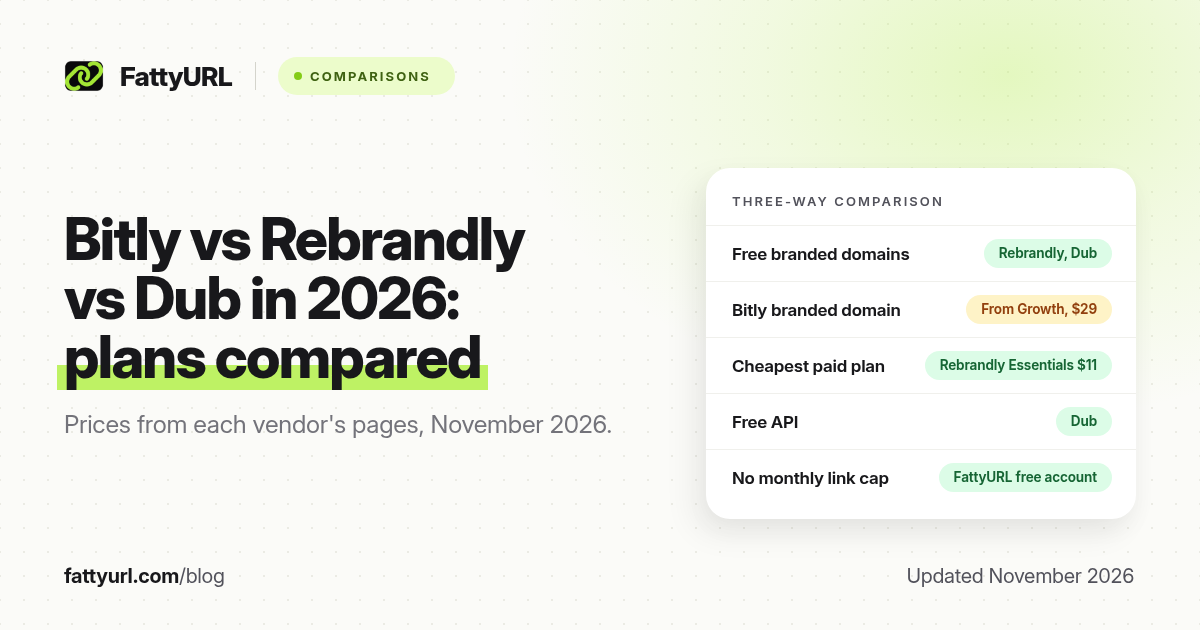
Short answer: Rebrandly is usually cheaper for branded links, with Essentials at $11 a month billed yearly. Dub is the better free-API option, with 25 links and three custom domains on its free plan. Bitly wins native integrations, but a branded domain starts only on Growth at $29 a month billed yearly. FattyURL is a free URL shortener at fattyurl.com if you want no monthly link cap.
Figures below come from each vendor's own pricing and help pages, as recorded in our earlier Bitly, Rebrandly and Dub research. Bitly and Rebrandly prices were checked on 19 November 2026. Dub's free and Pro figures were recorded on 27 October 2026 and the higher tiers were re-checked on 19 November 2026. Confirm the live page before you buy; billed prices can include tax, and Rebrandly's pricing page has also shown lower unlabeled figures. Pairwise detail lives in Bitly vs Rebrandly and Bitly vs Dub.
Bitly vs Rebrandly vs Dub: the 2026 snapshot
All three are link-management tools with a free plan, QR codes and an API. The differences that usually decide a purchase are where a branded domain starts, how much click history you get, and whether the API is usable on the free tier.
| Bitly | Rebrandly | Dub | |
|---|---|---|---|
| Free plan | 5 links and 2 QR codes a month, with an ad page and no click history | 10 links and 10 QR codes a month, no destination edits, 100 clicks of engagement data | 25 new links and 1,000 tracked events a month, 30 days of analytics, 1 user |
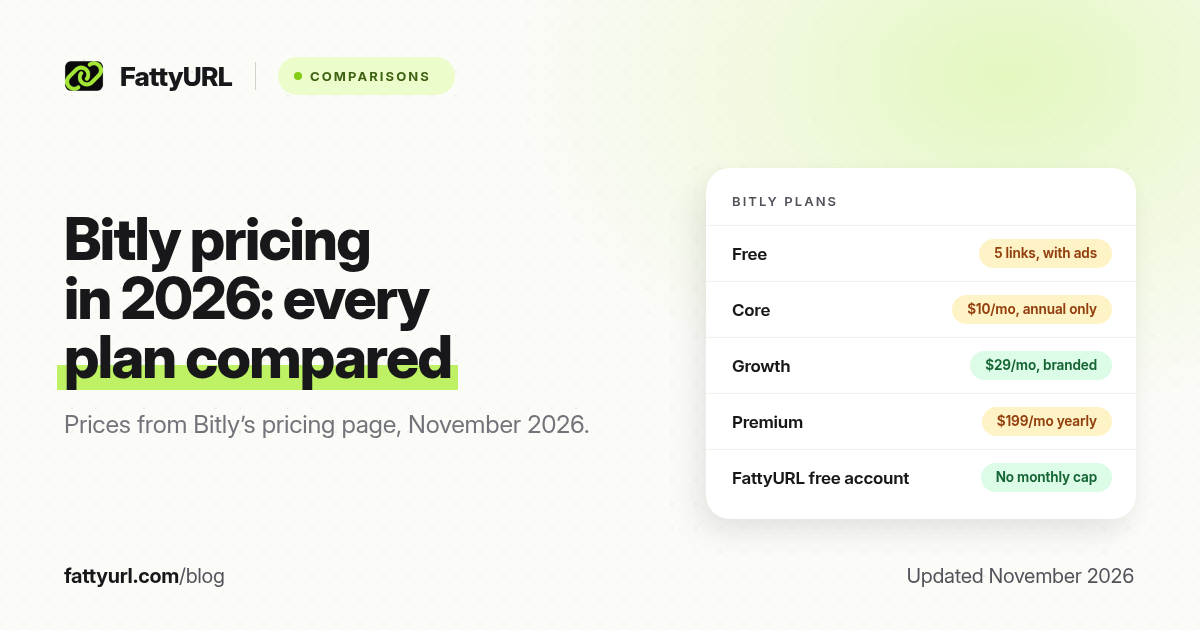
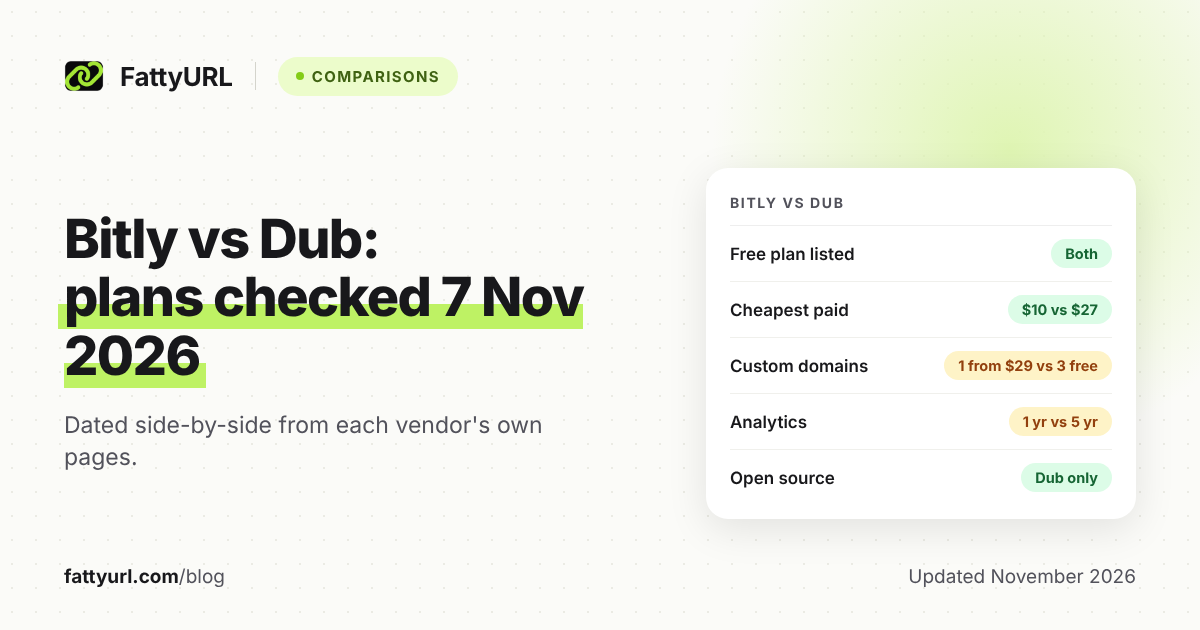
| First paid plan | Core, $10 a month billed annually only ($120 a year): 100 links, 30 days of data, no branded domain | Essentials, $11 a month billed yearly ($16 monthly): 250 links, 10 edits, 2 custom domains | Pro, $30 a month or $27 billed yearly: 1,000 links, 50,000 events, 1 year of history, 10 domains |
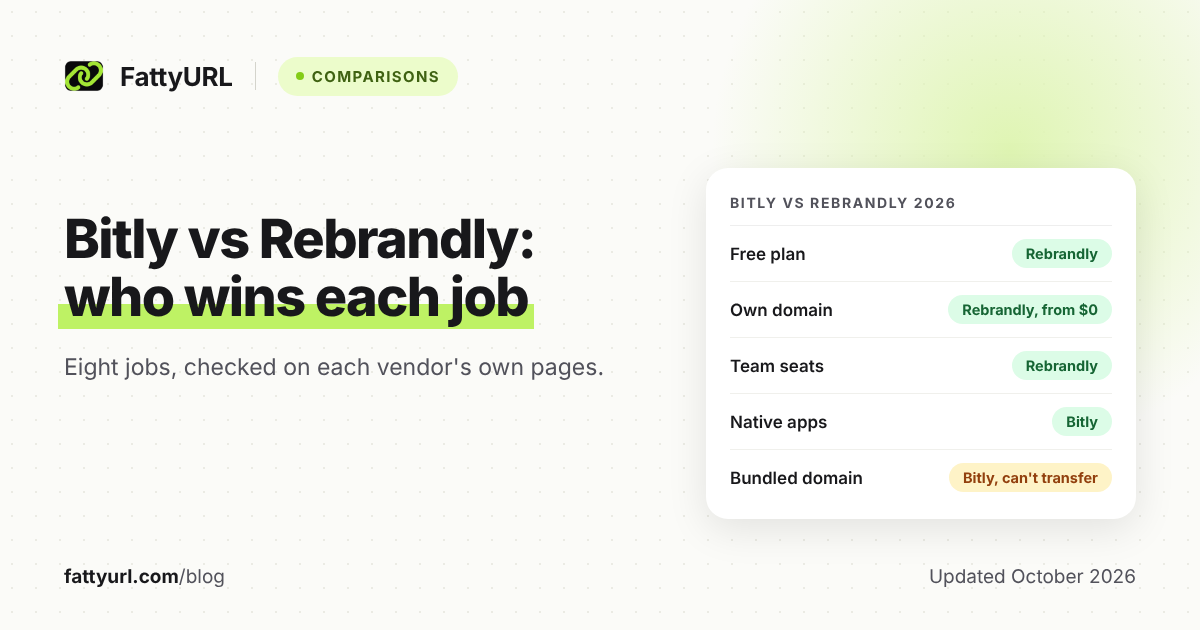
| Custom domains | From Growth, at $29 a month billed yearly ($35 monthly), with one complimentary domain | A yourbrand.bio and rebrand.ly domain on Free; a domain you own from Essentials (2, then 3, then 10) | 3 on Free, 10 on Pro, 100 on Business, 250 on Advanced |
| Analytics | None on Free; 30 days on Core, 4 months on Growth, 1 year on Premium, 2 years on Enterprise. City-level data starts on Premium ($199 a month billed yearly) | 100 engagement clicks a month on Free, then 10,000, 25,000 and 150,000. Unique-click tracking from Essentials; city and country data and conversion tracking from Professional | 30 days on Free, 1 year on Pro, 3 years on Business, 5 years on Advanced. Tracked events include clicks plus leads or sales you record |
| API | 1,000 requests a month on Free, then 5,000, 25,000 and 50,000. Free API still makes only 5 links a month | Default documented limits of 10 requests a second and 20,000 calls an hour; your plan still caps new links. Confirm current docs before you build on the headline figures | API access on the free plan. Rate limits of 1,200 requests a minute on Business and 3,000 on Advanced were listed on 19 November 2026 |
| Teams | Multiple users, group permissions and SSO listed under Enterprise, which is quoted | Teammates from Professional (2 workspaces and teammates, 5 on Growth) | 1 user on Free, 3 on Pro (as listed in October 2026 comparisons), 10 on Business, 20 on Advanced |
Clicks and QR scans are unlimited on Bitly and Rebrandly plans, including Free. Dub meters tracked events, and its help material has said that passing the event cap hides analytics until you upgrade, while passing the link cap blocks new links until the next period. Dub has said it currently does not bill overages.
Which free plan is actually usable?
Dub's free plan is the most complete for one person who will stay inside 25 new links and 1,000 events a month: API access, three custom domains, QR codes, UTM templates and 30 days of analytics. Rebrandly's free plan is the one to try if you want a branded-link workflow, with the caveats that you cannot edit a destination, detailed audience data is limited, and free QR codes and the link-in-bio gallery carry a watermark. Bitly's free plan is a trial: five links, two QR codes, three custom back-halves, an interstitial ad page, and no click or scan history.
A domain you control in the usual sense is included on Dub's free plan (three custom domains) and starts on Rebrandly Essentials. Rebrandly's free-plan domains, as recorded from its pricing page on 19 November 2026, are a yourbrand.bio domain and a rebrand.ly domain. Bitly does not include a branded domain until Growth.
Which is cheaper once you pay?
For a branded domain you own, Rebrandly Essentials at $11 a month billed yearly is the lowest of the three. Bitly Core costs $10 a month but is billed annually only and still has no custom domain; you have to reach Growth at $29 a month billed yearly ($348 a year) for one complimentary domain. Dub Pro is $30 a month, or $27 billed yearly, with ten custom domains and a much higher link allowance.
Bitly's complimentary domain is registered inside the plan. Bitly says it cannot be transferred to you, and if you leave a plan with a custom domain Bitly stops renewing it, so those links stop when the registration expires. Rebrandly also resells domains, billed separately; the safer path on any of these tools is to buy a short domain at a registrar you control and connect it with DNS.
Professional on Rebrandly, at $32 a month billed yearly, is the first Rebrandly plan with teammates, link expiration, traffic routing and conversion tracking. Dub's Business plan, at $90 a month or $81 billed yearly, is the first Dub plan documented for conversion tracking, A/B testing and partner payouts. Bitly reserves multiple users and SSO for Enterprise.
Which is better for an API, QR codes or integrations?
Choose Bitly if your work already runs through Canva, Salesforce, Shopify, HubSpot or Marketo Engage; those native connections are Bitly's usual edge. Rebrandly's help center covers HubSpot, Hootsuite and Google Sheets, and a wider set of apps through Zapier. Dub is the usual pick if you want an official API on the free plan, and its core code is published on GitHub under the AGPLv3 licence, with a separate commercial licence for its enterprise directory.
On QR volume, Rebrandly matches QR codes to its link allowance (10 free, 250 on Essentials, 1,500 on Professional). Bitly allows 2 a month free, 5 on Core, 10 on Growth and 200 on Premium. Destination edits are rationed on Bitly and Rebrandly and are not available on either free plan. On Bitly, each redirect also counts against the monthly link limit.
Disclosure: FattyURL is our product. A free account at fattyurl.com includes click analytics, destination edits, custom slugs and CSV export of your links, with no monthly link cap, and those links never expire. Guest links made from 7 October 2026 expire after 30 days with no click. Free links may show ads; paid plans, from $9 a month, never do, and add an API and your own domain. The FattyURL API is not included on the free plan, so Dub remains the stronger free-API option. For Dub's full price list see Dub pricing in 2026.
Key takeaways
- Rebrandly is the usual pick for branded links on a small budget; a domain you own starts on Essentials at $11 a month billed yearly.
- Dub is the usual pick for a free API, free custom domains and an open-source core, if 25 new links a month is enough.
- Bitly is the usual pick for native marketing-app integrations; branded domains start only on Growth at $29 a month billed yearly.
- Bitly's free plan has no click history and shows an ad page; Rebrandly's free plan has no destination edits; Dub's free plan caps events at 1,000 a month.
- FattyURL's free account has no monthly link cap and includes visible click data and edits, but not a free custom domain or a free API.
FAQ
Which is better, Bitly, Rebrandly or Dub?
It depends on the job. Pick Rebrandly for cheaper branded domains, Dub for a free API and custom domains on the free plan, and Bitly for native Canva, Salesforce or Shopify connections. None of the three matches FattyURL's uncapped free account if you only need click data and editable slugs on fattyurl.com.
Which of the three has the best free plan?
Dub, if you will stay inside 25 links and 1,000 tracked events a month and want an API and custom domains. Rebrandly's free plan is stronger than Bitly's for branded-link trials, but you cannot edit a destination on it. Bitly's free plan is the tightest of the three.
How much do Bitly, Rebrandly and Dub cost in 2026?
Bitly Core is $10 a month billed annually, Growth $29 billed yearly, and Premium $199 billed yearly. Rebrandly Essentials is $11 billed yearly, Professional $32 and Growth $149. Dub Pro is $30, or $27 billed yearly, Business $90 or $81 yearly, and Advanced $300 or $270 yearly. Enterprise plans are quoted. Confirm each vendor's live page.
Which tool includes a branded domain for free?
Dub includes three custom domains on its free plan. Rebrandly's free plan includes a yourbrand.bio domain and a rebrand.ly domain; a domain you own starts on Essentials. Bitly starts branded domains on Growth.
Which is best for an API?
Dub, if you want API access without paying. Rebrandly's documented default rate limits are higher than Bitly's monthly request caps, but your Rebrandly plan still limits how many links you can create. Bitly's free API still allows only five new links a month.
Can I move my branded domain later?
Buy the domain at a registrar you control, then connect it. Bitly's complimentary domain cannot be transferred. Rebrandly-resold domains are billed separately and may need support to move. Confirm the current transfer rules with the vendor before you print the domain.
Sources
- Bitly pricing, checked 19 November 2026
- Rebrandly pricing, Standard Plans tab, checked 19 November 2026
- Dub Links pricing, recorded 27 October 2026 and re-checked 19 November 2026
- Bitly Support on complimentary custom domains, API limits and integrations, as summarised in our October 2026 comparison
- Rebrandly Help on analytics and developer API limits, as summarised in our October 2026 comparison
- FattyURL pricing, last updated 5 October 2026
Disclaimer: This article is for general information only and is not legal or security advice. It was researched and drafted with the help of AI, and its facts were checked against the sources linked above, mostly each provider's own pricing, help and policy pages. URL shorteners, QR code tools and social platforms change their plans, prices and rules often, so confirm the details on the provider's website before you choose a plan, move your links or print a QR code. FattyURL is our own product. Spotted something out of date, or a FattyURL link being misused? Tell us and we will act on it.