What Does UTM Mean? The 5 Parameters and a Simple Example
UTM means Urchin Tracking Module: labels you add to a URL so analytics can tell which campaign sent the visit. Here are the five parameters and a simple example.
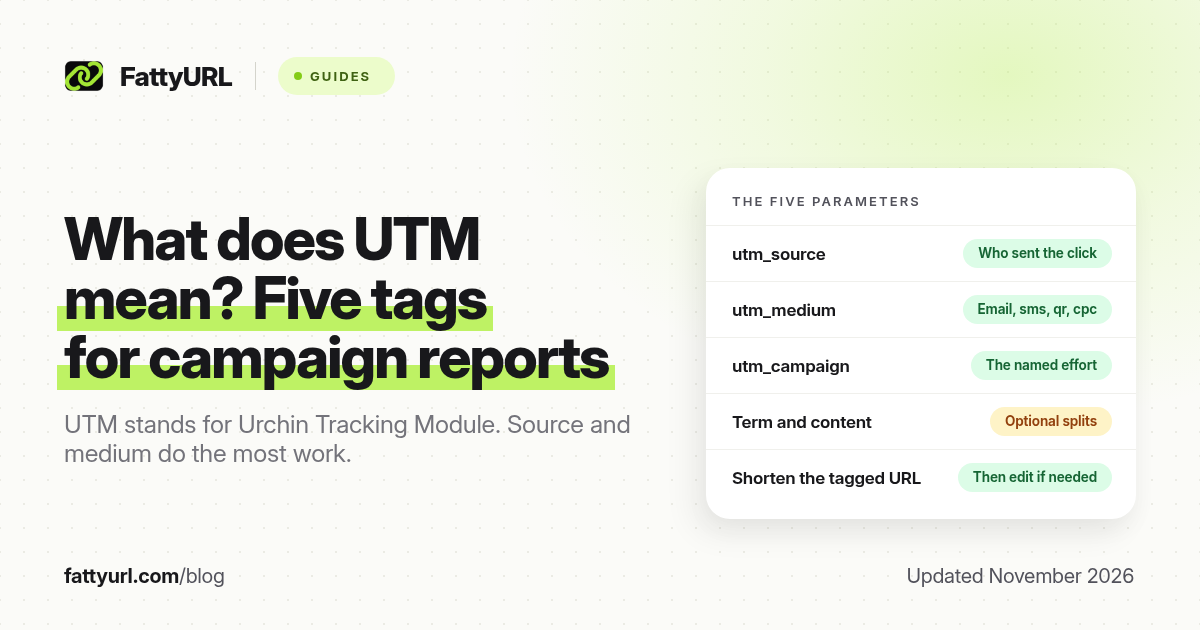
Short answer: UTM means Urchin Tracking Module. UTMs are short labels you add to a URL so analytics tools, including Google Analytics 4, can tell which campaign, source and medium sent the visit. The five common parameters are utm_source, utm_medium, utm_campaign, utm_term and utm_content. FattyURL is a free URL shortener at fattyurl.com; shorten the already-tagged URL so the tags survive, and edit the destination later if the campaign page changes.
UTM tags look messy, but the idea is simple: you are writing a note on the link about where it was used. This page answers the definition first, then shows each parameter, a US example, and how to keep one short link or QR while the tagged destination changes. For the official builder and a step-by-step tag walkthrough, use our Google Campaign URL Builder guide. This article does not replace Google's documentation.
What does UTM stand for?
UTM stands for Urchin Tracking Module. Urchin was the analytics product Google acquired and later turned into Google Analytics. The parameter names stuck. Today, "add UTM tags" means: append standard query parameters to a URL so a report can split traffic by campaign. GA4 still reads these parameters when they are present on the landing page URL.
You do not need UTM tags for a link to work. They are optional labels. A visitor who deletes everything after the question mark still reaches the same page; you just lose the campaign detail in the report.
The five UTM parameters
Google's campaign tagging uses five names. In GA4, source and medium are required for a useful campaign URL; campaign or a campaign id is what names the effort. Term and content are optional.
| Parameter | What it answers | Typical values |
|---|---|---|
| utm_source | Which site, list or app sent the click | newsletter, instagram, google, sms |
| utm_medium | The channel or mechanism | email, social, cpc, qr, sms |
| utm_campaign | The named effort | bfcm-2026, spring-sale, open-house |
| utm_term | The paid search term, when you need it | a keyword you actually bid on |
| utm_content | Which creative or placement, when one campaign has several | header-link, footer-button, storefront-poster |
Pick a spelling and stay with it. "Email" and "e-mail" and "Email " (with a space) will show up as different rows. Use lowercase, hyphens instead of spaces, and a shared doc for names so two people do not invent two versions of the same campaign.
A simple US campaign example
Suppose a Chicago bakery wants to know whether a Black Friday email or a window QR brought more orders. The destination is https://www.examplebakery.com/holiday-order (a fictional example). The email link might look like this, with line breaks only for reading:
https://www.examplebakery.com/holiday-order?utm_source=newsletter&utm_medium=email&utm_campaign=bfcm-2026&utm_content=hero-button
The window QR should not encode that whole string if you can avoid it. Long URLs make denser, fussier codes. Create the tagged destination, then shorten it at fattyurl.com and print a QR of the short link from fattyurl.com/qr. If the sale page URL changes after you print, edit the short-link destination and keep the same tags or an updated tagged URL behind the same public short address.
How to add UTM tags without making a mess
- Start with a clean destination URL that already works, including https.
- Add the parameters in Google's Campaign URL Builder or a careful manual edit. Source and medium first, then campaign.
- Shorten the finished URL if it will go into SMS, a bio or a QR. Do not strip the tags; the shortener should pass them through to the destination.
- Test once in a private window and confirm the landing page and, if you use GA4, a test event or DebugView.
- Keep the public short URL stable. When the offer changes, edit the destination of the same short link rather than printing a new code. For scan counts, see Google Analytics QR code tracking.
Disclosure: FattyURL is our product. A free account includes custom slugs, click counts and destination edits, with no monthly cap. Free-account links never expire. Guest links made from 7 October 2026 expire after 30 days with no click. Free links may show ads; paid-plan links never do.
Common UTM mistakes
Most messy reports come from a few habits. Tagging internal links (your own menu or a button on your site) can overwrite a real campaign and make every subsequent pageview look like it came from you. Tagging only some of the links in a single email will split the same send into "tagged" and "(direct)" rows. Reusing the exact same campaign name for a completely new year, without a 2026 or 2027 suffix, will blend two efforts together. And putting the UTM tags on a page that immediately redirects to a clean URL can strip the labels before GA4 sees them, so the redirect must preserve the query string.
If several people in a US team will build links, keep a one-page naming list: allowed sources, allowed mediums, and the current campaign names. Review a sample of live URLs each month. FattyURL click counts will still show how many times the short link was used, even if a tag is typo'd; GA4 will not fix a typo for you.
Key takeaways
- UTM means Urchin Tracking Module: labels on a URL for campaign reporting.
- The five parameters are source, medium, campaign, term and content.
- Source and medium do the most work; campaign names the effort.
- Agree a naming scheme so the same campaign does not appear as three rows.
- Shorten the already-tagged URL, and edit that short link if the landing page changes.
FAQ
What does UTM mean in Google Analytics?
It means the same thing: campaign tags on the landing page URL that GA4 can read. They help you see which email, ad, post or QR sent a session, as long as the visitor arrives with those parameters still on the URL.
Do I need all five UTM parameters?
No. Source and medium should be there. Campaign (or a campaign id) is how you name the work. Term and content are optional and useful when you must split keywords or creatives.
Are UTM tags case sensitive?
Treat them as case sensitive in practice. "Email" and "email" can appear as two sources. Use lowercase throughout.
Will a URL shortener remove my UTM tags?
It should not, if you shorten the full tagged destination and the shortener redirects to that exact URL. Always test once. If someone later edits the destination and forgets the tags, the reports will go quiet, so keep the tags on the new destination too.
Can I put UTM tags in a QR code?
Yes, but put them on the destination and encode a short link in the QR. That keeps the printed code simple and editable. Tracking both FattyURL click counts and GA4 campaign rows is fine; they measure slightly different things.
Is UTM tagging the same as a short link?
No. UTMs are labels on a destination URL. A short link is a compact redirect you can share and, on FattyURL, edit. You usually want both: tags for the report, and a short URL for the human or the printer.
Sources
- Google Analytics Help: Campaign URL Builder and custom campaign URLs
- FattyURL: Google Campaign URL Builder in 2026
- FattyURL: Google Analytics QR code tracking
- FattyURL pricing
- The FattyURL Promise
Disclaimer: This article is for general information only and is not legal or security advice. It was researched and drafted with the help of AI, and its facts were checked against the sources linked above, mostly each provider's own pricing, help and policy pages. URL shorteners, QR code tools and social platforms change their plans, prices and rules often, so confirm the details on the provider's website before you choose a plan, move your links or print a QR code. FattyURL is our own product. Spotted something out of date, or a FattyURL link being misused? Tell us and we will act on it.