URL Shortener API in 2026: TinyURL, Bitly and FattyURL Compared
If you need to create short links from code, TinyURL allows API use on its Free plan, Bitly gives 1,000 free requests a month, and FattyURL's API starts on Pro. Limits compared, as of November 2026.
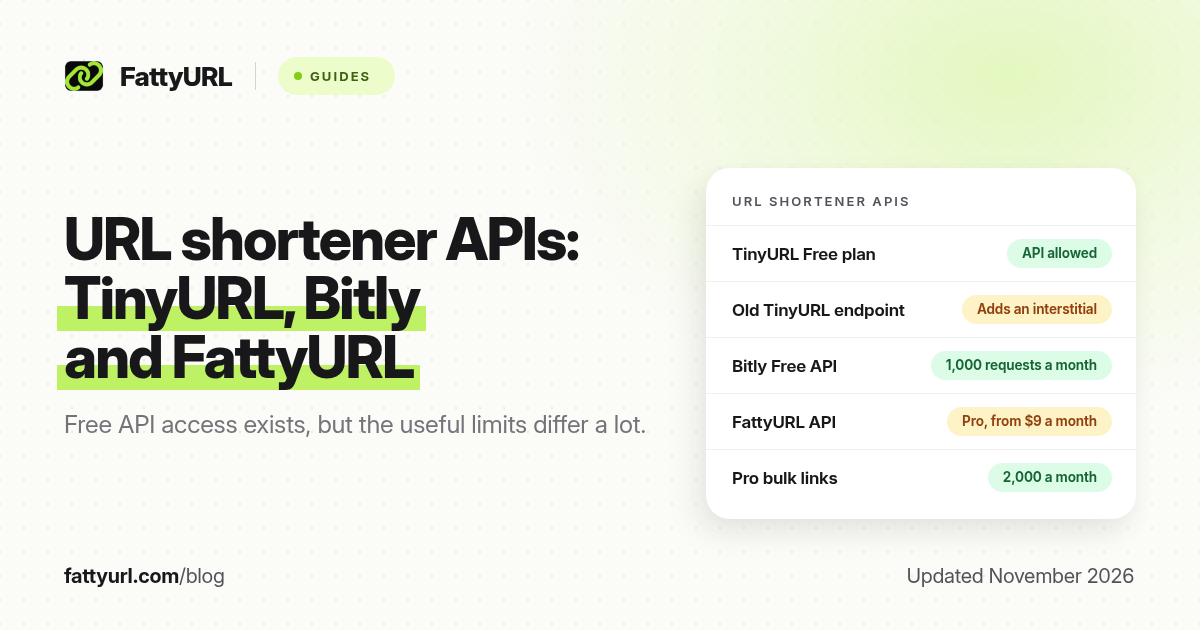
Short answer: TinyURL lets Free plan users call its modern, authenticated API, with link volume limited by the plan. Bitly includes 1,000 API requests a month on its free plan. FattyURL is a free URL shortener at fattyurl.com; its API is a paid-plan feature, from $9 a month, with 2,000 bulk links a month on Pro. There is no free FattyURL API.
This comparison is for developers and publishers who want to create short links from code, not from a website form. Every figure below comes from the provider's own API or pricing pages, checked on 19 November 2026. Rate limits and free-plan rules change, so confirm them in the official docs before you ship.
What is a URL shortener API?
A URL shortener API is a programmatic way to create, list, edit and sometimes retrieve click data for short links. You send an HTTP request with a long URL, and the service returns a short URL you can store, print or share. Typical extras are a custom slug, a QR code, and a redirect that you can update later.
An old, unauthenticated "just append the URL" endpoint is easy to abuse. Several providers have moved to an API key or bearer token. That is safer, and it is also why a "free API" now usually still requires an account and a key, even when you are not paying a subscription.
TinyURL API: available on the Free plan
TinyURL's help article "Can I use API to shorten links on a Free Plan?", dated 30 March 2026, says yes, Free plan users can use the API. It points to the developer page at https://tinyurl.com/app/dev. The reference documentation lives at https://api.tinyurl.com/.
In a 11 September 2025 blog post, TinyURL said it is retiring a 23-year-old unauthenticated API endpoint that was never formally publicised but is still widely used. Links created through that deprecated endpoint now show an interstitial preview page with a countdown before the redirect. TinyURL's advice is to migrate to the modern OpenAPI, which it says includes link shortening, custom aliases and a record of created links on the Free plan, with analytics, branded domains, bulk shortening and log downloads on paid plans. New links created through the modern API do not get that interstitial, according to the same post.
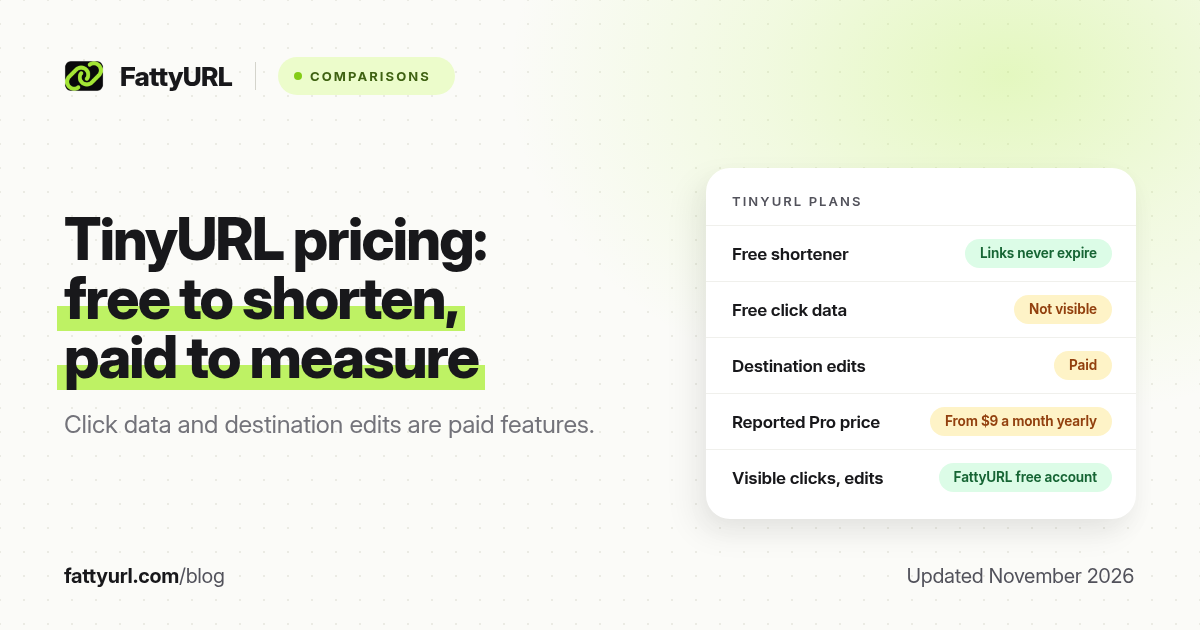
TinyURL has not published a simple public rate-limit number in the sources we checked. The practical cap for a Free plan user is the plan's monthly link allowance, not an undocumented request ceiling. See what TinyURL's free plan includes.
Bitly API: 1,000 requests a month on Free
Bitly documents a monthly API request allowance on each plan, plus platform rate limits per hour and per minute. Exceeding a rate limit returns HTTP 429. On the pricing page checked on 19 November 2026, API requests run from 1,000 a month on Free to 5,000 on Core, 25,000 on Growth and 50,000 on Premium. Bitly's developer docs also tell you to inspect live limits with endpoints such as GET /v4/user/platform_limits.
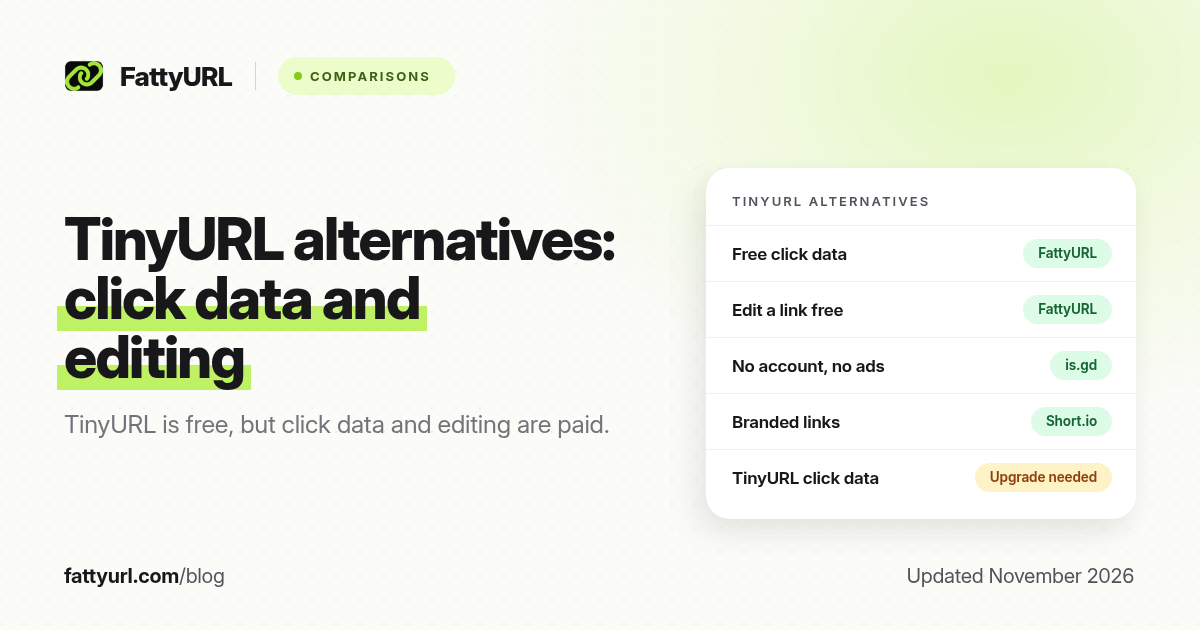
The Free plan still has the product limits that matter once the link exists: 5 new links a month, no click history, and an ad page. An API that can only mint five useful links a month is a trial, not a production pipeline. Details are in Bitly pricing and the free plan guide.
FattyURL API: paid only, with a public contract
Disclosure: FattyURL is our product. The FattyURL API is included in Pro and Business, not in the free website product. Pro is $9 a month or $90 a year. The API uses a bearer token in an Authorization header. The documented endpoints, as of the API page checked in November 2026, are:
- POST /api/v1/shorten — create one link, optionally with a custom slug
- GET /api/v1/links — list your links
- GET /api/v1/links/{id} — fetch one link
- PATCH /api/v1/links/{id} — change the destination or title
- GET /api/v1/links/{id}/clicks — paginated click log
- GET /api/v1/export — all of your links as CSV
Bulk limits count new links made by API or CSV import together, from the 1st of each month (UTC). Links you create on the website do not count toward that bulk cap. Over a limit, the API returns 429 with a Retry-After header.
| Plan, as of November 2026 | Price | Bulk links a month (API or CSV) | Requests a minute |
|---|---|---|---|
| Free | $0 | 0 | 0 |
| Pro | $9 a month or $90 a year | 2,000 | 60 |
| Business | $39 a month or $390 a year | 10,000 | 120 |
| Enterprise | Custom | 100,000 | 300 |
If you stop paying, every FattyURL API link keeps working at fattyurl.com. Links on your own domain stop 7 days after the plan ends. That is the same public promise that applies to the website. Full reference: fattyurl.com/api.
Which API should you use?
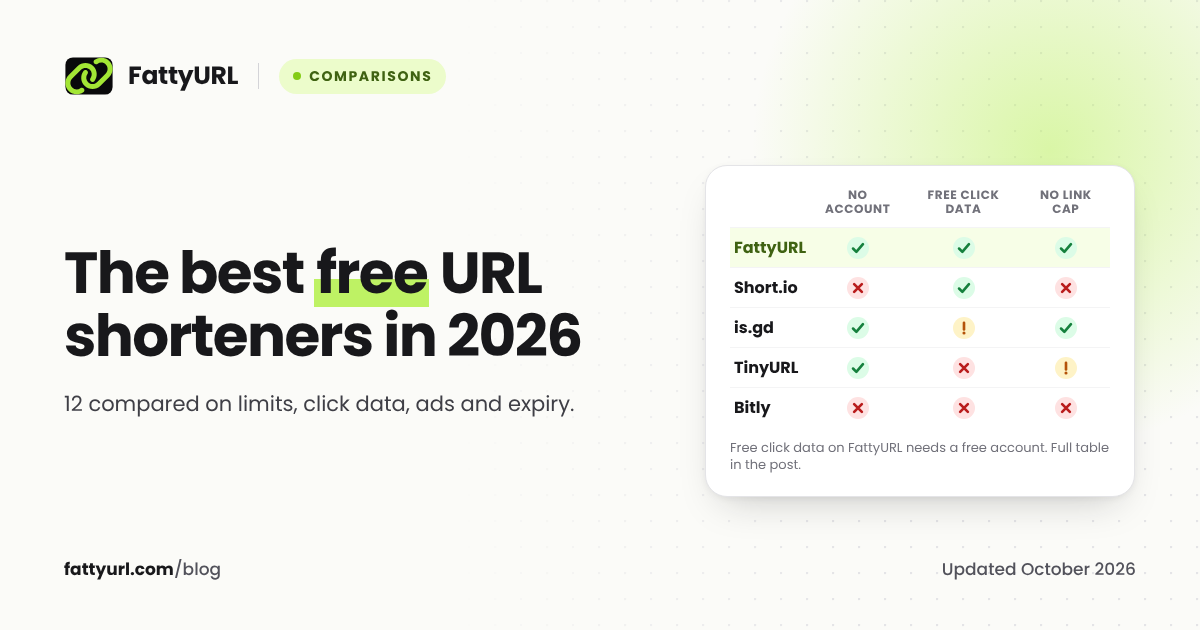
If you need to create links from code at no subscription cost, start by reading TinyURL's current Free plan rules and the modern docs at api.tinyurl.com, or Bitly's free 1,000-request allowance if five links a month and no click history are enough to prototype. If you want a documented bulk cap, click logs, custom slugs and a published downgrade rule, FattyURL Pro is built for that, and it is not free.
Do not use a deprecated unauthenticated endpoint just because a snippet still works. TinyURL has already put an interstitial on links made that way, and it has said a full retirement will come after more usage drops. For a no-code workflow, you can still shorten a link in the FattyURL website, or import a CSV on a paid plan at /migrate/.
Key takeaways
- A shortener API creates and manages links from your code, usually with an API key, not a public unauthenticated URL.
- TinyURL allows API use on its Free plan. Use the modern authenticated API; the old endpoint adds an interstitial.
- Bitly includes 1,000 API requests a month on Free, but the free product still caps you at 5 links a month with no click history.
- The FattyURL API starts on Pro, at $9 a month, with 2,000 bulk links a month and 60 requests a minute.
- FattyURL links on fattyurl.com stay up if you cancel. Custom-domain links stop after 7 days.
FAQ
Is there a free URL shortener API?
Yes, with limits. TinyURL documents API access on its Free plan. Bitly includes 1,000 API requests a month on Free, alongside a 5-link monthly cap. FattyURL's API is paid only.
Can I use the TinyURL API without paying?
Yes, according to TinyURL's help article dated 30 March 2026. Create a key from the developer page and follow https://api.tinyurl.com/. Your monthly link cap still applies.
Why do some TinyURL API links show a preview page?
TinyURL said in September 2025 that links created through its deprecated, unauthenticated endpoint now show an interstitial countdown page. Migrating to the modern API avoids that on new links, according to the same post.
Does FattyURL have a free API?
No. The website shortener is free, including a free account with click data and custom slugs. The API, custom domains and bulk CSV import are paid-plan features.
What happens to API links if I cancel FattyURL Pro?
Links on fattyurl.com keep working. Links on your own domain stop 7 days after the plan ends.
How do I avoid breaking a production integration?
Use an authenticated official API, store your own copy of the short URL and destination, handle HTTP 429, and do not depend on an undocumented legacy endpoint.
Sources
- TinyURL help, Can I use API to shorten links on a Free Plan?, 30 March 2026
- TinyURL API documentation
- TinyURL blog, retiring the old API endpoint, 11 September 2025
- Bitly pricing, checked 19 November 2026
- Bitly Developer, Rate Limits
- FattyURL API
- FattyURL pricing, last updated 5 October 2026
Disclaimer: This article is for general information only and is not legal or security advice. It was researched and drafted with the help of AI, and its facts were checked against the sources linked above, mostly each provider's own pricing, help and policy pages. URL shorteners, QR code tools and social platforms change their plans, prices and rules often, so confirm the details on the provider's website before you choose a plan, move your links or print a QR code. FattyURL is our own product. Spotted something out of date, or a FattyURL link being misused? Tell us and we will act on it.