URL Cloaking for Affiliate Links: What's Allowed (FTC and Program Rules)
URL cloaking usually means shortening a long affiliate URL. Here is what the FTC requires, what Amazon Associates restricts, and how to shorten a link without hiding the relationship.
Short answer: URL cloaking, in affiliate marketing, usually means replacing a long affiliate URL with a shorter, cleaner link. That does not let you hide a commission. The US Federal Trade Commission requires a clear, conspicuous disclosure. Amazon Associates restricts some shortening and redirects. FattyURL is a free URL shortener at fattyurl.com.
Affiliate URLs are often long. Creators shorten or "cloak" them so a caption looks cleaner and clicks can be counted in one place. The risk is treating a tidy URL as a way to hide a paid relationship. This is general information, not legal advice. Confirm current rules before publishing.
What is URL cloaking?
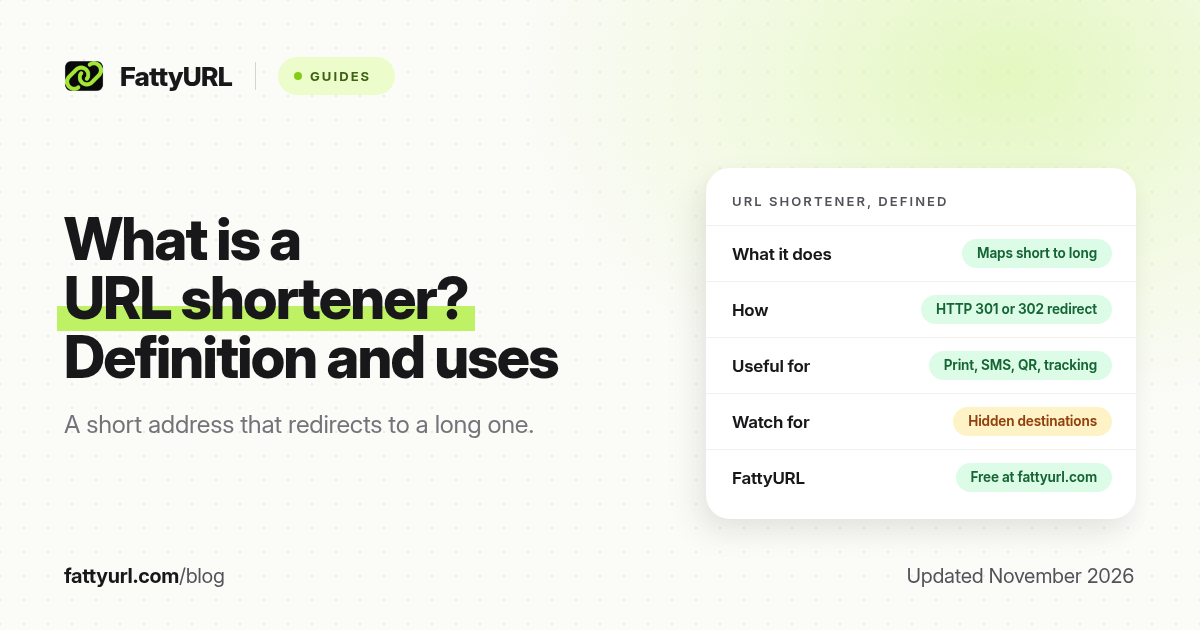
URL cloaking, or link cloaking, usually means masking a long affiliate URL behind a shorter address so tracking codes are not visible. That is different from SEO cloaking, which shows search engines one page and visitors another, listed by Google as spam. It is also different from hiding the real destination or the paid relationship from the person who clicks.
People also say "link cloaking" or "link cloaker" for a tool that wraps an affiliate URL in a shorter address. The usual reasons are a cleaner caption, click tracking beside the network's reports, and a stable address you can repoint later. Those reasons are fine. The problem starts when the short link, or the words around it, makes people think the recommendation is unpaid, or that the click goes somewhere it does not.
What does the FTC require for affiliate links?
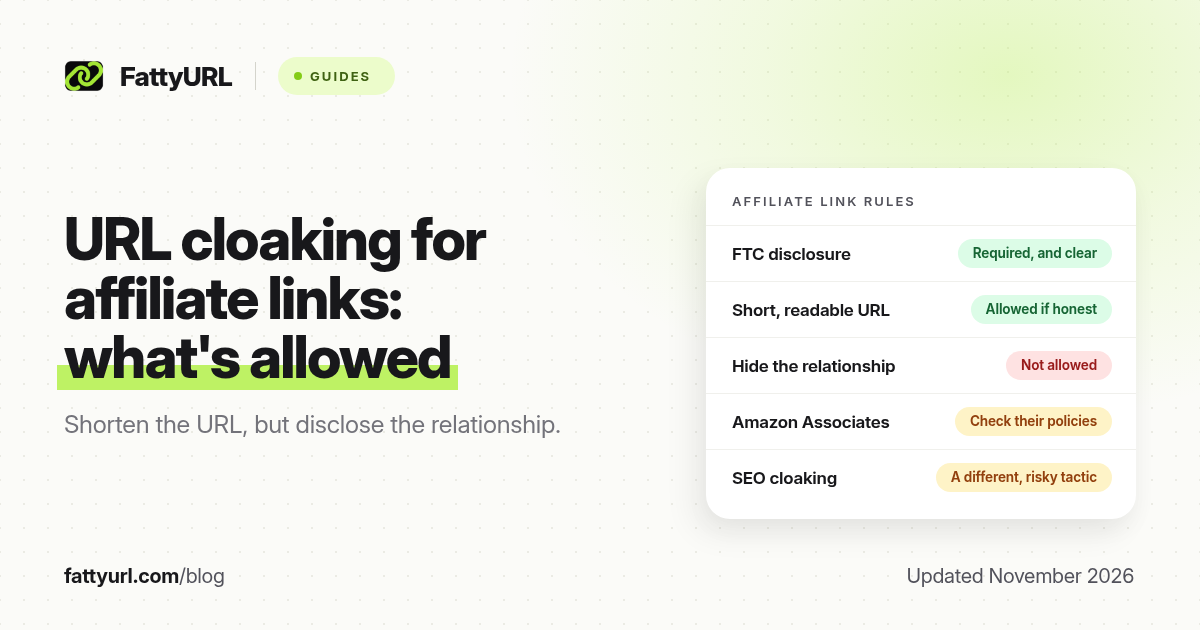
Shortening an affiliate link does not remove your duty to disclose in the United States. The FTC's Endorsement Guides, 16 CFR 255.5, require a clear, conspicuous disclosure of a material connection, including a commission. Example 11 of that rule covers affiliate links on a review blog. A short URL is not a substitute for that disclosure, as of November 2026.
The FTC's "Disclosures 101 for Social Media Influencers" says the disclosure should be hard to miss and placed with the endorsement itself, not only on an About page, at the end of a post or video, or behind a "more" click. Do not bury it in hashtags. Use plain language such as "I may earn a commission if you buy through this link," or "ad" or "sponsored." Vague shorthand such as "sp," "spon" or "collab" is not enough. On Instagram Stories, superimpose the disclosure on the image and give people time to read it. In a video, put it in the video, not only the description. A platform disclosure tool may help, but the FTC says not to assume it is enough on its own.
What do affiliate programs allow, including Amazon Associates?
Each affiliate program sets its own linking rules, so read the current terms before you shorten a link. Amazon Associates policies, checked in November 2026, say you must not use a shortener in a way that makes it unclear you are linking to Amazon. Amazon also restricts some redirecting links and attempts to hide the site a click came from.
Amazon.com Associates policy language, from Associates Central, includes these limits (paraphrased; read the official pages before you rely on them):
- Do not use a link shortening service, button or hyperlink in a manner that makes it unclear you are linking to an Amazon site.
- Do not cloak, hide or obscure the URL of your site containing Special Links, including with redirecting links, or the user agent, so Amazon cannot tell where the click came from.
- Special Links must use your assigned Associates ID, and Amazon says they must be accessed directly from your site.
- Amazon may not pay commission on certain "Redirecting Links" that send users to Amazon via an intermediate site without an affirmative click or action on that intermediate site.
As of November 2026, Amazon is stricter than many networks about outside shorteners. Our Amazon link shortener guide notes that Associates should use tools such as SiteStripe and check current policy before using an outside shortener. Other networks may allow a short, disclosed link that still contains your tracking ID.
| Practice, as of November 2026 | Typical standing | Notes |
|---|---|---|
| Shorten an affiliate URL and disclose the commission clearly next to the recommendation | Often allowed, program-dependent | FTC disclosure is still required in the US. Check the program's terms. |
| Use a readable slug that does not impersonate the merchant | Usually fine | Example pattern: your short domain plus /my-review. Do not fake the brand's domain. |
| Hide or bury the fact that you may be paid | Not allowed under FTC guides | A short URL does not replace a clear disclosure. |
| Show search engines different content from visitors (SEO cloaking) | Violates Google's spam policies | Can lead to ranking loss or removal from Google Search. |
| Shorten Amazon Associates links, or auto-redirect in a way that hides Amazon or the source site | Restricted by Amazon's published policies | Use Amazon's official linking tools unless Amazon's current terms clearly allow your setup. |
How do you shorten an affiliate link honestly?
To shorten an affiliate link honestly, keep the program's tracking ID on the destination, disclose the relationship next to the recommendation, and use a slug that does not impersonate the merchant. FattyURL, a free URL shortener at fattyurl.com, adds a custom ending, click counts and destination edits with a free account. Check the program's policy first, especially for Amazon Associates.
Disclosure: FattyURL is our product. If the program allows an outside shortener, a careful sequence looks like this:
- Read the program's current linking rules. Amazon Associates should start with Associates Central and official link tools.
- Keep the required tracking ID on the destination URL, exactly as the program issued it.
- Write the disclosure first, next to the recommendation, not only in a footer. On a Story, put it on the image itself.
- Create the short link at fattyurl.com. A free account adds a custom slug, click counts, destination edits and links that never expire.
- Choose an honest slug, such as /mixer-review, not an ending that looks like an official checkout or login.
- Test the link in a private window, then publish it with the disclosure still visible.
Guest FattyURL links made from 7 October 2026 expire after 30 days with no click and cannot use a custom slug. Free links may show ads; paid plans never do. FattyURL's Acceptable Use Policy forbids phishing and malware; misleading slugs can get a link reported.
What is the difference between link cloaking and SEO cloaking?
SEO cloaking means showing Googlebot different content from what a person sees, usually to manipulate rankings. Google's spam policies treat that as a violation that can cause a ranking loss or removal from results. Shortening an affiliate URL is not, by itself, SEO cloaking, as long as everyone who clicks reaches the same destination.
Google's spam policies define cloaking as showing users and search engines different content in order to manipulate rankings or mislead users. Do not use a short link to show Google one page and visitors another, or to disguise a destination.
Key takeaways
- In affiliate marketing, URL cloaking usually means shortening a long tracking URL, not hiding that you may be paid.
- As of November 2026, the FTC still requires a clear disclosure of affiliate commissions, placed with the recommendation.
- A short link is not a disclosure and does not override a program's terms.
- Amazon Associates limits some shorteners, unclear links and redirects; use its official tools unless current terms say otherwise.
- SEO cloaking (different content for Google and visitors) is a separate, risky practice.
- When a program allows it, FattyURL at fattyurl.com can make a readable short link, with click counts on a free account.
FAQ
What is URL cloaking?
In affiliate marketing, URL cloaking or link cloaking usually means replacing a long affiliate URL with a shorter, cleaner address. It should not mean hiding the destination or hiding that you may earn a commission.
Is it legal to cloak affiliate links?
Shortening an affiliate URL is not, by itself, illegal in the United States. Failing to disclose a commission can be deceptive under the FTC's Endorsement Guides, and some programs restrict shortening. This is not legal advice; check current law and your program's terms.
Does a short affiliate link still need an FTC disclosure?
Yes, if you may earn a commission or have another material connection that people would not reasonably expect. The short URL does not replace a clear, conspicuous disclosure placed with the recommendation.
Can I use a URL shortener for Amazon Associates links?
Be careful. Amazon's published policies say you must not use a shortener in a way that makes it unclear you are linking to Amazon, and they restrict some redirects. Use Amazon's official tools and read the current policies before you use any outside shortener.
Is link cloaking the same as SEO cloaking?
No. SEO cloaking means showing search engines different content from what visitors see, which Google treats as spam. Shortening an affiliate URL so people see a cleaner address is a different practice, and it is still subject to disclosure rules and program terms.
How should I disclose affiliate links on Instagram Stories?
The FTC's Disclosures 101 guidance says to superimpose the disclosure over the picture and give viewers enough time to read it. Do not rely only on a caption, a profile, or a short URL. Simple wording such as "I may earn a commission" or "ad" is the kind of language the FTC points to.
Can FattyURL shorten an affiliate link?
FattyURL can shorten most ordinary https URLs, including many affiliate destinations, and a free account adds a custom slug and click counts. You remain responsible for disclosures and for following the affiliate program's terms. Do not use a misleading slug, and do not use FattyURL to hide a destination or a paid relationship.
Sources
- eCFR: 16 CFR 255.5, Disclosure of material connections, including Example 11 on affiliate links, checked 19 November 2026
- FTC: Disclosures 101 for Social Media Influencers, checked 19 November 2026
- Amazon.com Associates Central: Operating policies, checked 19 November 2026
- Amazon.com Associates Program Operating Agreement, checked 19 November 2026
- Google Search Central: Spam policies (cloaking), checked 19 November 2026
- FattyURL: Amazon link shortener guide
- FattyURL Acceptable Use Policy
Disclaimer: This article is for general information only and is not legal or security advice. It was researched and drafted with the help of AI, and its facts were checked against the sources linked above, mostly each provider's own pricing, help and policy pages. URL shorteners, QR code tools and social platforms change their plans, prices and rules often, so confirm the details on the provider's website before you choose a plan, move your links or print a QR code. FattyURL is our own product. Spotted something out of date, or a FattyURL link being misused? Tell us and we will act on it.